Partial Roof Replacement & Section Reroof Pensacola
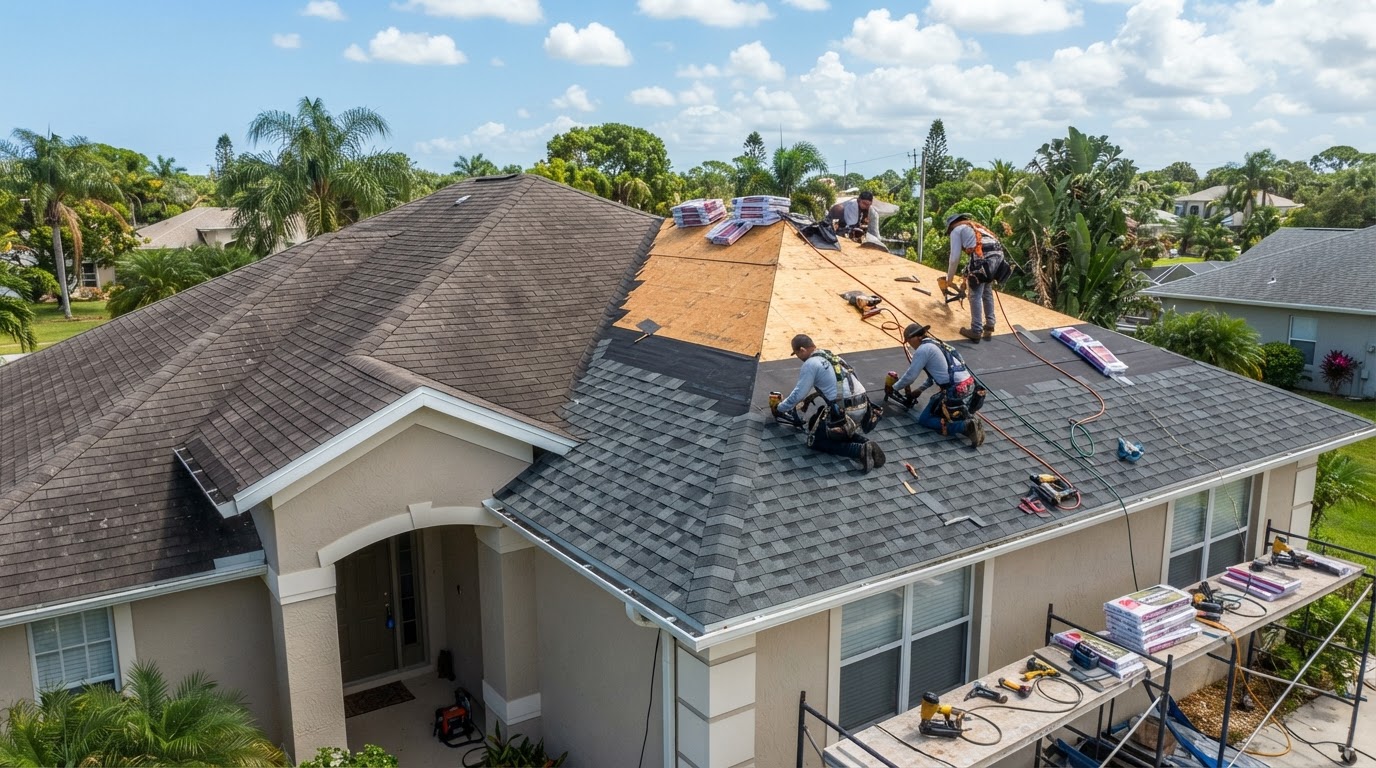
Not every damaged roof needs a full replacement. When storm damage, a chronic leak, or a material failure is confined to one roof plane, a partial roof replacement—sometimes called a section reroof—can address the problem without reroofing the entire home. Feasibility depends on the roof's age, material availability, decking condition, adjoining roof sections, code requirements, and the overall state of the roof. We evaluate partial reroofing across Pensacola and Escambia County honestly: when it makes sense, we say so, and when a full replacement is the better long-term answer, we say that too.
A partial roof replacement replaces only the damaged section of a roof rather than the entire roof surface. It may be appropriate when damage is isolated to one plane, such as a single storm-damaged slope or a chronically leaking valley. Feasibility depends on roof age, material availability for matching, decking condition, the condition of adjoining sections, and local code requirements—which in Pensacola and Escambia County can involve Florida's 25% roof rule when a large portion of the roof is affected. A section reroof is not always the cheapest or correct solution.
When Partial Replacement May Make Sense
A partial reroof targets a specific, isolated problem. It works best when the rest of the roof is in good condition and the damage is clearly confined. The goal is to fix the failed section without tearing off roofing that still has useful service life. However, partial replacement is not automatically the right call—roof age, material matching, and code requirements all factor in.
- Localized storm damage confined to a single roof slope or plane
- One failed roof plane with an identifiable cause while others remain sound
- Addition or extension roof that was installed separately and is failing independently
- Tree impact damaging a concentrated area without affecting the full roof
- Chronic leak isolated to one section, such as a single valley or penetration cluster
- Material failure in one area due to installation defect or manufacturing issue
- Separate roof elevations with different ages or exposures that age unevenly
We do not imply partial replacement is always the cheapest or correct solution. In some cases the cost of matching materials, the risk of future failures on remaining sections, and code considerations make a full replacement more economical over the long run. The decision is based on the actual condition of the roof, not a preference for a smaller project.
When Full Replacement May Be Better
Sometimes a partial reroof creates more problems than it solves. If the roof is near the end of its service life, has multiple failing areas, or the damaged section represents a large percentage of the total roof, Florida's building code can trigger a full replacement requirement. In those cases, patching one section while the rest is about to fail simply delays the inevitable and can cost more overall.
- Widespread deterioration across multiple slopes, not just one
- Multiple leaks in different areas pointing to systemic aging
- Older roofing system near the end of its useful service life
- Matching problems—discontinued shingles or visible weathering differences
- Deck deterioration discovered beneath the damaged section suggesting broader issues
- Repeated repairs that no longer keep pace with ongoing failures
- Large percentage of the roof affected, potentially triggering Florida's 25% roof rule
- Code or permitting implications that require full-code compliance on the repaired area
Related replacement and inspection services
Matching Shingles & Roof Sections
The biggest practical challenge in a partial reroof is matching the new shingles to the existing roof. Even when the same product line is available, weathering, batch variation, and color shifts mean a new section will rarely look identical to the older roof around it. We set realistic expectations so homeowners understand what a section reroof will look like before committing to it.
- Color variation—new shingles are fuller in color than weathered existing shingles
- Weathering—existing shingles fade and granule-wear over years of Florida sun
- Discontinued products—older shingle lines may no longer be manufactured
- Profile changes—even current product lines may have shifted dimensions
- Batch differences—same product from different runs can show slight color shifts
- Ridge and valley transitions—blend points where the new section meets old
- Flashing continuity—ensuring water flows seamlessly across the transition
A newly reroofed section will almost always look newer and slightly different than the surrounding roof. If a seamless appearance is important to you, that visible difference is a real factor in the partial-versus-full replacement decision. We show you what to expect rather than promising an invisible repair.
Causes of Localized Roof Damage Near Pensacola
Pensacola's Gulf Coast weather creates specific patterns of localized roof damage. Wind uplift tends to hit roof edges, ridges, and the slopes facing the prevailing wind first. Fallen branches from storms concentrate damage where they land. Wind-driven rain finds weak flashing and valley points. Understanding these patterns helps explain why damage is often isolated—and why a section reroof can sometimes be the right targeted response.
- Wind uplift—edge and ridge areas lift first, often damaging one slope
- Fallen branches—tree impact damages a concentrated area without affecting the full roof
- Wind-driven rain—forces water beneath weak flashing or valley points on one plane
- Flashing failure—a single failed flashing point allows water into one section
- Ridge and edge damage—high-wind exposure damages ridges and eaves selectively
- Differential aging—slopes with different sun or wind exposure age at different rates
These localized damage patterns are common across Pensacola, Escambia County, and the western Florida Panhandle, where tropical systems and thunderstorms frequently produce concentrated wind and debris damage. The same conditions that create isolated damage, however, can also reveal broader weakness—so an inspection of the full roof always accompanies a section reroof evaluation.
The Partial vs Full Replacement Evaluation
Deciding between a partial and full replacement is a judgment call based on the roof's overall condition, not just the visible damage. We inspect the full roof—not only the damaged section—because the rest of the roof determines whether a section reroof is sound or simply a stopgap. The evaluation considers age, material matchability, deck condition, code requirements, and the percentage of the roof affected.
- 1Full roof inspection—assess the damaged section and the condition of all other slopes
- 2Damage assessment—determine the extent and cause of the localized damage
- 3Roof age evaluation—compare the remaining service life of the existing roof
- 4Material matchability—check whether the existing shingle is still available
- 5Deck inspection—verify the sheathing beneath both damaged and adjoining areas
- 6Code review—assess whether the repair scope triggers Florida's 25% roof rule
- 7Recommendation—present partial vs full replacement with honest trade-offs
- 8Written scope and estimate—document the recommended approach and pricing
Frequently Asked Questions
Not Sure If You Need a Partial or Full Roof Replacement?
Contact Pensacola Metal & Shingle Roofing Contractors for a detailed written estimate across Pensacola, Escambia County, and Santa Rosa County.
Request Your Roofing Estimate
Direct consultation for Pensacola & Escambia County residential and coastal properties.