
Shingle Roof Leak Repair Pensacola
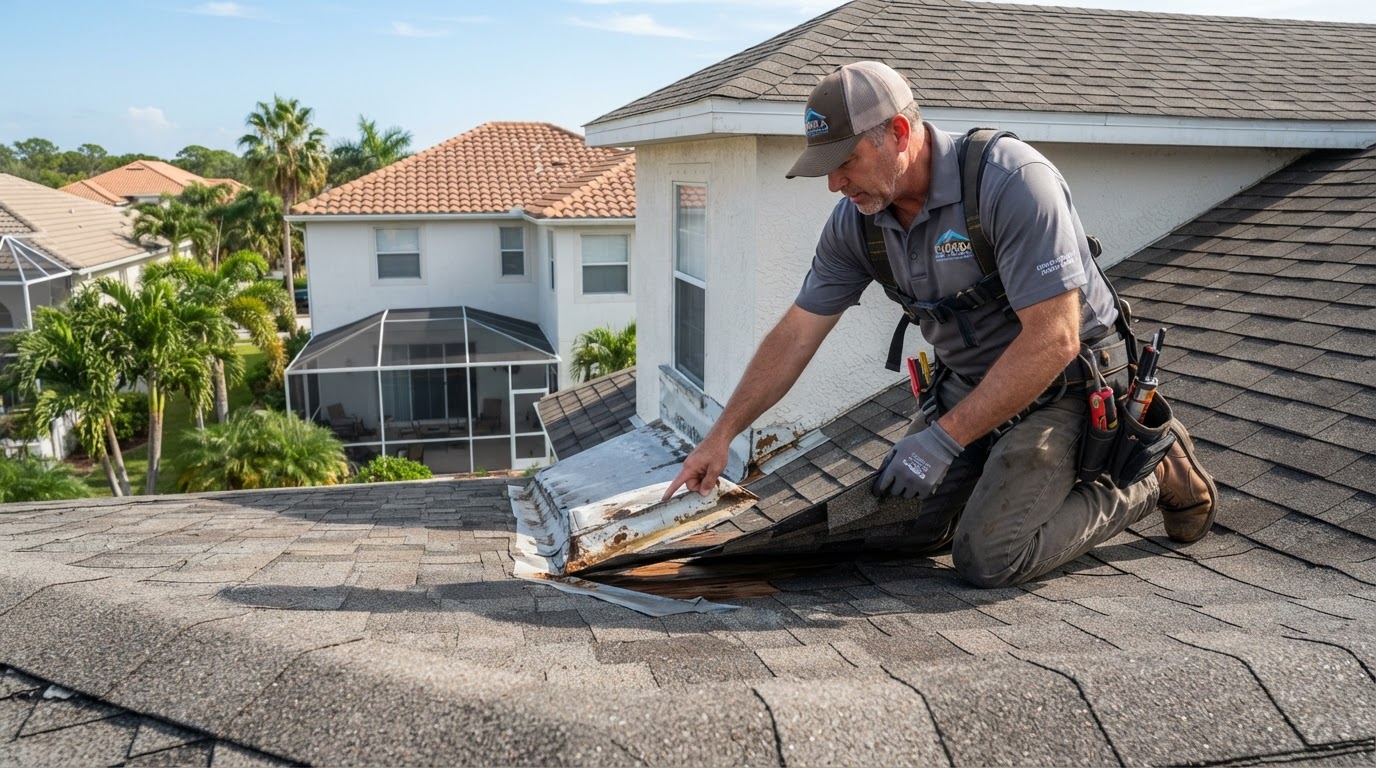
Water appearing inside a home does not always originate directly above the visible stain. Shingle roof leaks commonly involve flashing, valleys, penetrations, damaged shingles, or wind-driven rain that travels from an entry point to a different interior location. Diagnosing a leak correctly is the first step in repairing it—guessing at the source leads to patches that do not hold. We diagnose and repair shingle roof leaks across Pensacola and Escambia County, tracing water to its actual entry point and fixing the root cause rather than the visible symptom.
Shingle roof leak repair is the diagnosis and repair of water intrusion through an asphalt shingle roof. Leaks commonly originate at flashing, valleys, pipe penetrations, skylights, damaged shingles, or wind-driven rain entry points—not necessarily directly above the interior stain. In Pensacola and Escambia County, leak diagnosis involves inspecting the roof surface, attic, flashing, and penetrations to trace water to its actual entry point before any repair is made. A correct diagnosis is essential; patching the visible stain without finding the source rarely stops the leak.
Common Sources of Shingle Roof Leaks
Most shingle roof leaks do not start in the middle of a shingle. They start at the seams and transitions where different roof parts meet—flashing at walls and chimneys, valleys where two roof slopes intersect, pipe boots around plumbing vents, skylight curbs, and ridge vent installations. Missing or damaged shingles and wind-driven rain forcing water beneath seals are also common. Knowing where leaks typically start focuses the diagnosis on the likely culprits rather than the entire roof.
- Missing shingles—exposed underlayment or deck where shingles have blown off
- Lifted or creased shingles—tabs lifted by wind that allow water beneath the seal
- Nail penetrations—exposed or backed-out nails that let water through the deck
- Valleys—intersections of two roof slopes where water concentrates and flashing fails
- Pipe boots—cracked or deteriorated flashing around plumbing vent penetrations
- Skylight flashing—failed flashing or curb seals around skylight openings
- Chimney and wall flashing—step and counter flashing that separates from the surface
- Ridge vents—improperly installed or deteriorated ridge vent that admits water
- Roof-to-wall intersections—where a roof meets a vertical wall and flashing fails
Specific leak repair subservices
How Roof Leak Diagnosis Works
Diagnosing a roof leak is a process of tracing water from the visible symptom back to its entry point. Water travels along rafters, decking, and framing before it appears as a ceiling stain, so the stain is often feet away from the actual leak. A thorough diagnosis combines interior symptoms, attic inspection where accessible, and roof surface inspection to find where water is actually entering.
- Interior symptoms—ceiling stains, bubbling paint, or dampness that indicate water presence
- Attic inspection—tracing water paths on rafters and sheathing where accessible
- Roof surface inspection—examining shingles, flashing, and penetrations above the leak area
- Flashing check—inspecting step, counter, valley, and penetration flashing for gaps
- Penetration inspection—checking pipe boots, vents, and skylights for failures
- Water path tracing—following moisture from the interior symptom to the exterior entry
- Deck condition—checking for soft or water-damaged sheathing beneath the leak
- Moisture evidence—looking for water staining, mold, or rot that reveals the path
We do not guarantee source identification without an inspection. A leak's actual entry point cannot be confirmed by looking at an interior stain alone. The diagnosis requires inspecting the roof surface, attic, and flashing to trace the water—guessing at the source leads to patches that do not hold.
What to Do After Discovering a Leak
If you discover a roof leak, the priority is protecting your home and yourself while arranging professional inspection. Water can travel a surprising distance from its entry point, and wet roofs are dangerous to walk on. These steps protect your belongings and your safety while you wait for a diagnosis and repair.
- Protect belongings—move furniture and valuables away from the leak area
- Control interior water—place a bucket or container to catch dripping water where safely possible
- Document visible damage—photograph ceiling stains, water paths, and any visible roof damage for insurance
- Avoid climbing onto wet roofs—a wet roof surface is a serious fall hazard; leave inspection to a professional
- Arrange professional inspection—contact a roofer to diagnose the source and repair the leak
For severe storm situations
Leak Repair vs Roof Replacement
A single, well-diagnosed leak on a roof with remaining service life is a repair candidate. But leaks are often a symptom of broader aging. When leaks recur, appear in multiple areas, or coincide with an aging roof, the pattern may point toward replacement rather than continued patching. We assess the whole roof—not just the active leak—before recommending a path.
- Repeated leaks—the same area or multiple areas leaking after repairs suggest systemic aging
- Widespread aging—a roof near the end of its service life with multiple failure points
- Multiple failed areas—several leaks in different locations pointing to overall deterioration
- Severe storm damage—extensive damage that makes targeted repair impractical
- Damaged deck—rotten or water-damaged sheathing beneath the leak area
- End-of-life roofing—a roof that has reached the point where repairs no longer keep up
When repair becomes replacement
Shingle Roof Leaks in Pensacola's Climate
Pensacola's Gulf Coast climate creates specific leak patterns. Wind-driven rain during tropical systems forces water horizontally beneath flashings and shingle seals in ways that ordinary rain does not. Heavy downpours overwhelm valleys and gutters. Humidity and condensation in poorly ventilated attics can mimic a roof leak. Understanding these local patterns helps distinguish a true roof leak from other moisture sources and focuses the diagnosis where Pensacola weather actually attacks a roof.
- Wind-driven rain—forces water beneath flashings and seals during tropical events
- Heavy downpours—overwhelm valleys, gutters, and drainage paths
- Humidity and condensation—attic moisture that can mimic a roof leak without an exterior entry
- Aging flashing—Florida sun and salt air accelerate flashing deterioration
- Storm-damaged shingles—lifted and creased shingles that admit water after high winds
- Penetration failures—pipe boots and vents that crack under UV and thermal cycling
We reference Pensacola and Escambia County naturally because the local climate genuinely shapes the leak patterns we diagnose. A leak that appears only during wind-driven rain points to a different source than one that appears during any rain, and the diagnosis reflects that distinction.
Frequently Asked Questions
Have a Shingle Roof Leak in Pensacola?
Contact Pensacola Metal & Shingle Roofing Contractors for a detailed written estimate across Pensacola, Escambia County, and Santa Rosa County.
Request Your Roofing Estimate
Direct consultation for Pensacola & Escambia County residential and coastal properties.