Asphalt Shingle Roof Repair Pensacola
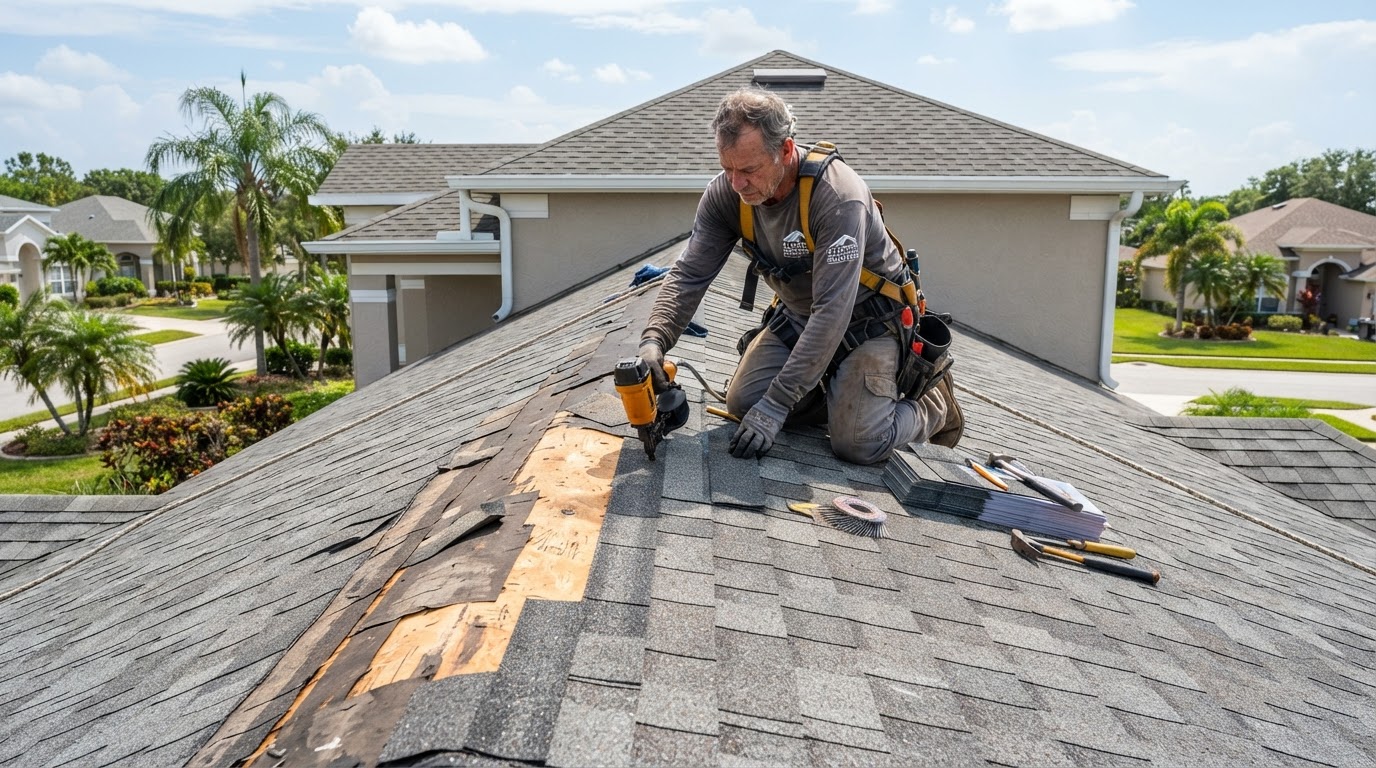
Shingle roof repair addresses the physical damage that Pensacola's wind, storms, and aging inflict on an asphalt roof—missing shingles, lifted and creased tabs, cracked courses, granule loss, damaged ridge caps, and failed flashing. Not every damaged roof needs a full replacement; many shingle problems are isolated and repairable when the rest of the roof still has service life. We diagnose and repair asphalt shingle roofs across Pensacola and Escambia County, and we tell you honestly when a repair is sound and when the pattern of damage points toward replacement instead.
Asphalt shingle roof repair fixes isolated physical damage to a shingle roof—missing shingles, lifted or cracked tabs, granule loss, damaged ridge caps, valley problems, and flashing failures—without replacing the entire roof. In Pensacola and Escambia County, most shingle repairs follow wind events and storms, but aging and humidity also drive recurring issues. Whether a repair is appropriate depends on the roof's age, the extent of damage, the number of leaks, and whether the rest of the roof still has useful service life.
Common Shingle Repairs Near Pensacola
Shingle damage in Pensacola follows predictable patterns. Wind lifts and tears tabs, especially at edges and ridges. Storms dislodge shingles and crease them where they fold back. Aging dries the asphalt so it cracks and sheds granules. Flashing and penetrations fail at the seams where different roof parts meet. We repair each of these failure types with targeted fixes when the surrounding roof is sound.
- Missing shingles—replacing shingles blown off during high-wind events
- Lifted shingles—re-sealing or replacing tabs lifted by wind before water enters
- Cracked shingles—replacing shingles cracked by UV drying and thermal cycling
- Granule loss—evaluating exposed mat and protecting areas where granules have worn away
- Damaged ridge caps—replacing ridge and hip caps that lift and fail in wind
- Valley problems—repairing valley flashing and shingles where water concentrates
- Pipe boot problems—replacing cracked or failed pipe boot flashing
- Flashing leaks—renewing step, counter, and wall flashing that allows water beneath shingles
- Wind damage—repairing creased, folded, and torn shingles after storms
Shingle Repair vs Replacement
The hardest judgment call in shingle repair is knowing when a repair is sound and when the pattern of damage means replacement is more economical. A roof with isolated storm damage and years of remaining life is a good repair candidate. A roof with widespread aging, multiple leaks, and recurring failures is reaching the point where repairs no longer keep up. We assess the whole roof—not just the visible damage—before recommending either path.
- Roof age—a newer roof with isolated damage is a strong repair candidate
- Extent of damage—localized damage favors repair; widespread damage favors replacement
- Number of leaks—multiple leaks in different areas suggest systemic aging
- Deck condition—sound decking supports repair; rot suggests deeper problems
- Material availability—if matching shingles are unavailable, replacement may be needed
- Storm exposure—repeated storm damage on an aging roof accelerates the replacement decision
- Repair history—a roof needing frequent repairs is approaching replacement
When repair becomes replacement
Storm-Damaged Shingle Repairs
Pensacola storms produce a recognizable set of shingle damage patterns. After a high-wind event or tropical system, we commonly see lifted tabs, creased shingles folded back at the crease line, missing sections where shingles have torn away, wind-driven rain intrusion beneath flashings, branch impacts, and ridge damage. Each requires a different repair approach, and some storm damage may be covered by insurance—but we do not assume coverage; that is determined by the homeowner's policy and claim.
- Lifted tabs—shingle tabs lifted by wind that need re-sealing or replacement
- Creased shingles—shingles folded back at the crease line and weakened
- Missing sections—shingles torn away exposing underlayment or deck
- Wind-driven rain—water forced beneath flashings and shingle seals
- Branch impacts—punctures and bruising from fallen limbs
- Ridge damage—ridge caps and hip shingles dislodged by wind
Storm recovery resources
We do not claim that all storm damage is covered by insurance. Coverage depends on the homeowner's policy, the cause of damage, the deductible, and the claim process. We document damage thoroughly to support a claim, but the insurer determines coverage—not the roofing contractor.
Shingle Repair in Pensacola's Climate
Pensacola's climate creates a specific mix of shingle stresses that drive repair demand. Gulf winds lift and crease shingles, tropical weather tears them away, heavy rain tests flashings, the Florida sun dries the asphalt base, and humidity feeds algae that darkens the surface. These forces repeat season after season, so even a well-built roof accumulates damage over time. Understanding the local pattern helps explain why certain repairs recur and when they signal deeper aging.
- Gulf winds—lift and crease shingle tabs, especially at edges and ridges
- Tropical weather—tears shingles and tests flashing during storm events
- Heavy rain—finds weak flashing and seal points, driving leak repairs
- Florida sun—dries the asphalt base, causing cracking and granule loss
- Humidity—feeds algae growth that darkens and ages the shingle surface
- Repeated seasonal exposure—accumulates damage that eventually points to replacement
We reference Pensacola and Escambia County naturally because these conditions genuinely shape the repair patterns we see. A roof in a more sheltered inland location ages differently than one exposed to Gulf winds, and the repair history reflects that difference.
The Shingle Repair Process
A shingle repair is not just replacing a damaged piece—it starts with understanding why the damage occurred and whether the surrounding roof is sound. We inspect the damaged area and the roof around it, identify the cause, determine whether a repair is appropriate, and execute a targeted fix. If the inspection reveals broader issues, we say so rather than patching over a problem that will recur.
- 1Inspection—assess the damaged area and the condition of surrounding shingles
- 2Cause diagnosis—determine whether damage is storm-related, age-related, or a flashing failure
- 3Repair-vs-replacement assessment—evaluate whether a repair is sound or the roof needs more
- 4Material matching—source the closest available shingle match for the repair
- 5Targeted repair—replace damaged shingles, flashing, or ridge caps as needed
- 6Surrounding check—verify adjacent shingles and flashing are intact
- 7Final review—confirm the repair is watertight and document the work
Connected services
Frequently Asked Questions
Have Damaged Shingles on Your Pensacola Roof?
Contact Pensacola Metal & Shingle Roofing Contractors for a detailed written estimate across Pensacola, Escambia County, and Santa Rosa County.
Request Your Roofing Estimate
Direct consultation for Pensacola & Escambia County residential and coastal properties.