Standing Seam Metal Roof Replacement & Installation Pensacola
Standing seam is the architectural end of metal roofing: continuous panels joined by raised interlocking ribs with every fastener and clip hidden beneath the seam. For Pensacola homeowners who want a clean, modern roof line and the lowest exposed-penetration maintenance of any metal system, standing seam pairs refined appearance with strong Gulf Coast wind performance. We install and replace standing seam across Pensacola, Escambia County, and the coastal communities of Gulf Breeze, Navarre, and Pensacola Beach where concealed fasteners are especially valuable against salt air and UV.
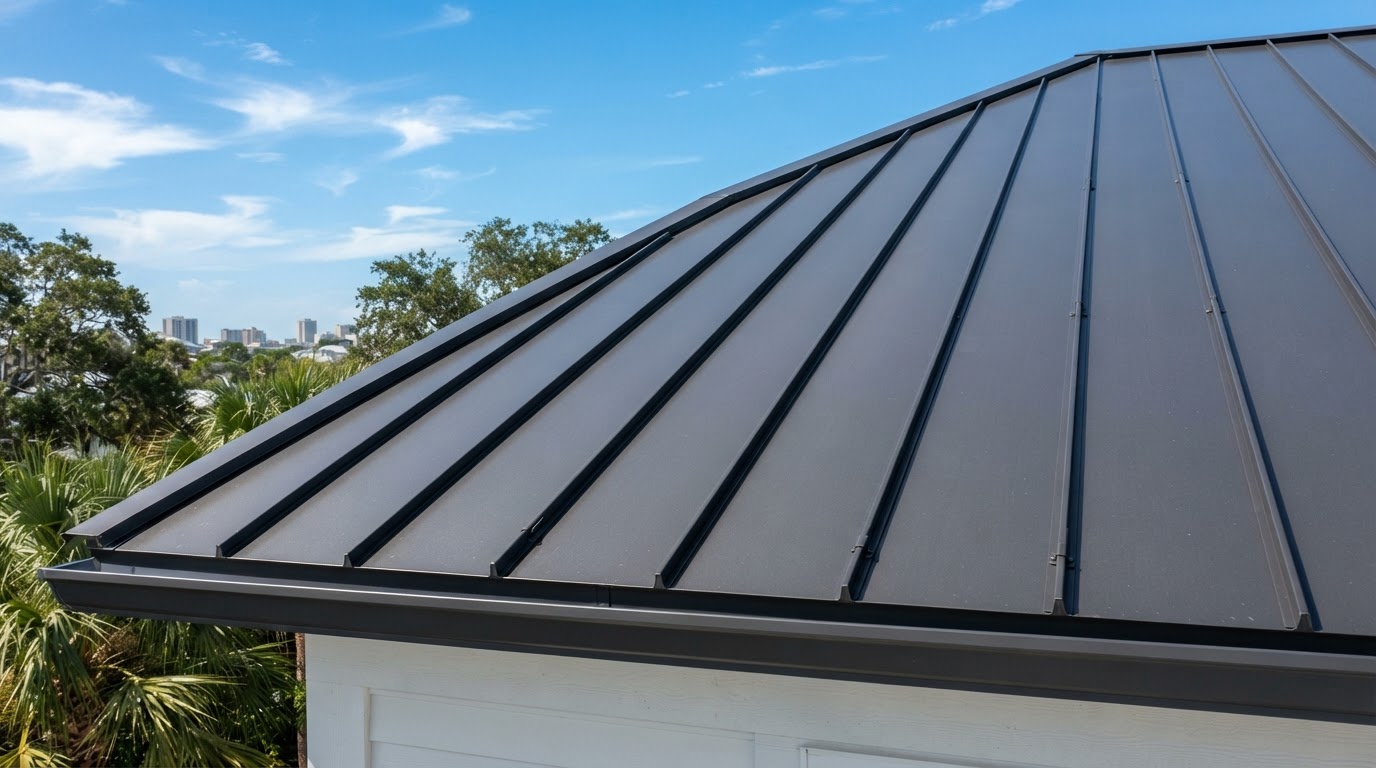
Standing seam metal roofing is a panel system in which adjacent panels are joined by raised vertical seams that lock together, and the clips and fasteners that hold the roof down sit concealed beneath those seams. Because no screws pierce the exposed face of the panel, there are no washers to degrade in the sun and no penetrations where wind-driven rain can enter. Homeowners choose standing seam for its clean appearance, low maintenance, strong wind uplift resistance, and compatibility with solar mounting.
Why Pensacola Homeowners Choose Standing Seam
The defining feature of standing seam is also its biggest advantage: the fasteners are concealed. On an exposed-fastener roof, every screw head and rubber washer is exposed to Florida sun, salt, and thermal cycling, and those gaskets are the components that eventually age. Standing seam removes that vulnerability by locking the attachment hardware beneath the raised seam, leaving a smooth, uninterrupted panel face.
- Concealed fastening eliminates exposed screw penetrations across the roof field
- Expansion and contraction: sliding clip systems let panels move with Florida heat without stressing fasteners
- Clean architectural appearance with continuous, uninterrupted panel lines
- Lower exposed-fastener maintenance—no routine washer replacement across the field
- Strong long-term durability potential when installed with proper underlayment and flashing
- Solar compatibility: clamp attachments mount to the raised seams without piercing the panel
- Coastal applications benefit from fewer exposed points for salt to attack
We avoid stating absolute lifespan or wind guarantees. Standing seam offers exceptional performance potential, but real-world results depend on gauge, substrate, coating, clip engineering, underlayment, and the quality of flashing and deck preparation—not a single number that fits every roof.
Standing Seam System Options for Coastal Florida
Standing seam is not one configuration. The way the seam is formed, the panel width, the metal substrate, and the gauge all change how the roof behaves. Understanding these options helps you compare quotes on substance rather than price alone.
- Mechanical lock vs snap-lock: mechanically seamed panels are field-crimped for the highest wind and weathertightness; snap-lock panels snap together for faster installation
- Panel width: typically 12 to 24 inches; wider panels offer a bolder look, narrower panels handle complex roof geometry more gracefully
- Seam height: taller ribs add stiffness and wind performance and create a more pronounced shadow line
- Steel vs aluminum: Galvalume steel for rigidity and value; aluminum for maximum saltwater corrosion resistance
- 24 vs 26 gauge: 24-gauge is heavier and more resistant to oil-canning and wind creasing; 26-gauge is code-compliant and common for residential use
- Factory finishes: Kynar 500 / PVDF coatings resist chalking and coastal color fade far better than lower-grade paints
- Cool-roof color considerations: lighter, reflective colors reduce heat gain in the Florida sun
Standing Seam Near Pensacola's Coast
Coastal exposure is where standing seam earns its premium. On Pensacola Beach, Perdido Key, Gulf Breeze, and Navarre, salt-laden air and high-velocity wind zones make exposed fasteners a long-term liability. Concealing the fasteners under the seam removes the most common failure point of coastal metal roofs—UV- and salt-degraded gaskets—so the system's longevity is driven by the panel substrate and coating rather than by washer replacement cycles.
That does not mean one specification fits every coastal property. A home a few hundred feet from the Gulf on Pensacola Beach may warrant marine-grade aluminum with a PVDF finish, while a home a mile inland in Gulf Breeze might be well served by Galvalume steel. We recommend material and coating based on your exact location within Escambia and Santa Rosa counties, not a blanket spec.
Coastal service areas
Standing Seam Replacement & Installation Considerations
Standing seam rewards careful substrate preparation. Because the system is meant to last decades, every layer beneath it should be built to the same standard. These are the considerations we evaluate during a standing seam replacement or new installation in Pensacola.
- Roof deck: verify sheathing integrity and re-nail to current Florida Building Code high-wind requirements
- Tear-off decisions: full removal is common for replacement; roof-over only where deck and code allow
- Underlayment: synthetic or self-adhering peel-and-stick as a secondary water barrier beneath the panels
- Flashings: step, counter, and edge flashing detailed to channel wind-driven rain away from transitions
- Penetrations: pipe boots, vents, and skylights sealed with compatible, long-life flashing details
- Valleys: lined and detailed to move large volumes of Gulf Coast downpour without backup
- Ridge systems: vented or solid ridge finished to match panel profile and ventilation plan
- Ventilation: balanced ridge and soffit flow to manage attic heat and humidity
- Existing shingles: evaluated for whether a roof-over is permissible or tear-off is required
- Solar planning: seam spacing and orientation considered if panels may be added later
Frequently Asked Questions
Planning a Standing Seam Roof in Pensacola?
Contact Pensacola Metal & Shingle Roofing Contractors for a detailed written estimate across Pensacola, Escambia County, and Santa Rosa County.
Request Your Roofing Estimate
Direct consultation for Pensacola & Escambia County residential and coastal properties.