Stone-Coated Steel Roof Replacement & Installation Pensacola
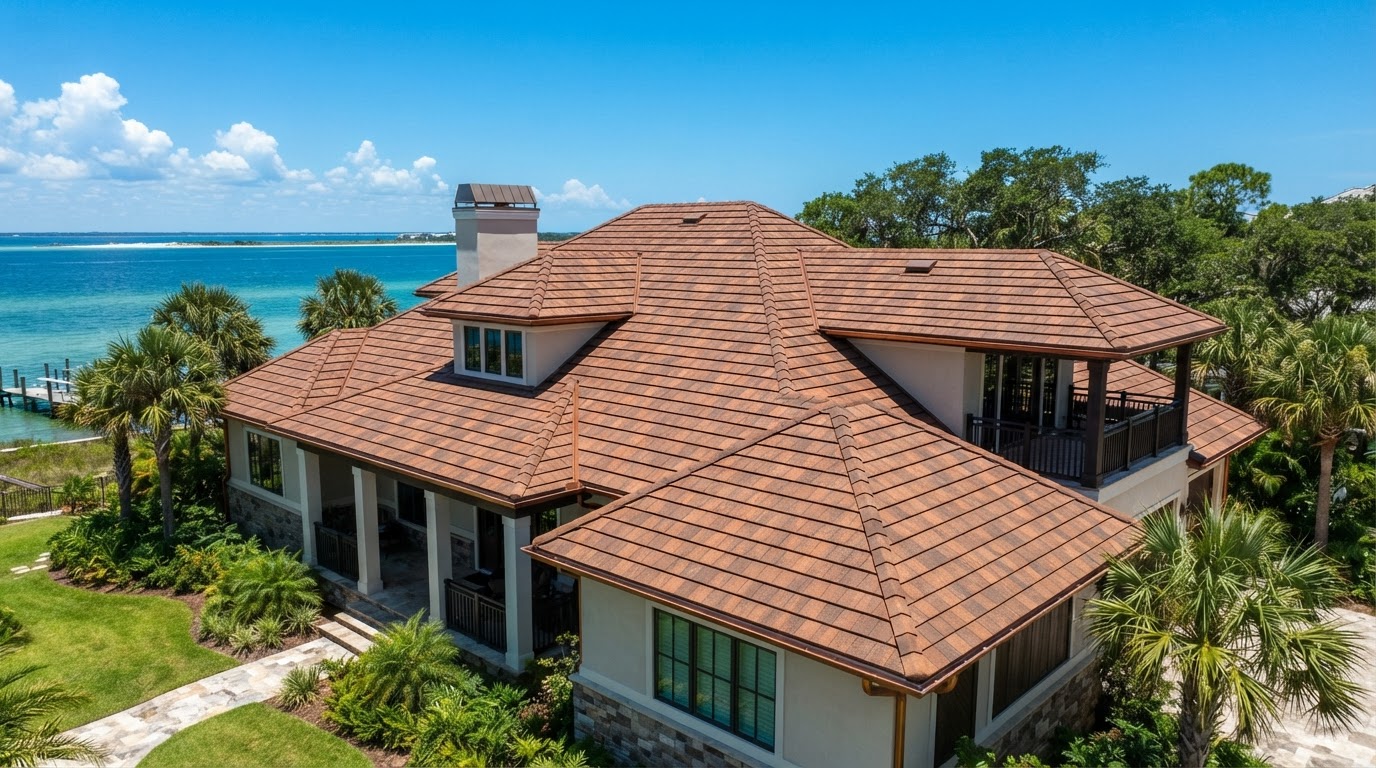
Stone-coated steel roofing gives Pensacola homeowners a way to get metal performance without a metal look. A steel panel core is armored with ceramic stone granules in profiles that resemble shingles, tile, or shake, delivering the durability and low weight of metal behind a traditional architectural appearance. We install and replace stone-coated steel across Pensacola, Escambia County, and Santa Rosa County for homeowners and HOA-regulated neighborhoods where a metal roof must read as tile or shake.
Stone-coated steel roofing is a metal roof made from a steel panel core bonded to ceramic stone granules that give it the textured appearance of shingles, tile, or shake. It combines the structural strength and light weight of metal with a traditional, non-metallic look—making it a common choice where a homeowner wants metal's durability and wind performance but an HOA or design preference calls for tile or shake aesthetics.
Stone-Coated Steel Style Options & Home Design
The appeal of stone-coated steel is that it does not look like a metal panel. The stone granule surface mimics traditional roofing materials, so a home can gain metal's performance while preserving a tile, shake, or shingle character. These are the common profile families.
- Shingle profiles that mimic the look of architectural asphalt shingles
- Tile profiles echoing Mediterranean and Spanish barrel-tile aesthetics
- Shake profiles resembling hand-split cedar without cedar's maintenance and fire concerns
- Textured architectural systems with deep shadow lines and dimension
Not every manufacturer offers every profile or color. Available styles depend on the product line we specify for your roof, and we confirm exact profile and color availability during your estimate rather than implying all options are universally stocked.
Stone-coated steel is often chosen by homeowners whose HOAs or deed restrictions require a tile or shake appearance but who do not want the extreme weight, fragility, or maintenance of concrete tile or natural cedar shake. It delivers that look on a far lighter, more impact-resistant platform.
Stone-Coated Steel vs Shingles & Standing Seam
Stone-coated steel sits in a useful middle ground: more durable than asphalt shingles and more traditional-looking than standing seam. Understanding where it falls helps you decide if it is the right fit.
| Factor | Stone-Coated Steel | Architectural Shingles | Standing Seam |
|---|---|---|---|
| Appearance | Tile, shake, or shingle look | Dimensional shingle | Continuous metal panels |
| Weight | Light, far below concrete tile | Moderate | Light |
| Fastening | Horizontal interlocking panels | Nailed shingle tabs | Concealed clips |
| Maintenance | Low, no exposed field fasteners | Moderate over time | Minimal |
| Material structure | Steel core with stone granules | Fiberglass mat and asphalt | Solid metal panel |
| Coastal considerations | Good with proper substrate and coating | Granule loss in coastal climate | Excellent near saltwater |
| Budget positioning | Premium, above shingles | Most accessible | Premium |
We do not claim stone-coated steel is universally superior. For a homeowner focused on lowest upfront cost, architectural shingles may be the better fit; for maximum low-maintenance coastal performance, standing seam may edge it out. Stone-coated steel wins when you want metal durability in a traditional profile.
Stone-Coated Steel in Pensacola's Climate
Pensacola's climate tests every roof: high wind, torrential rain, humidity, intense UV, and—nearer the coast—salt air. Stone-coated steel's interlocking panels and impact-resistant surface address several of these well, but performance still depends on correct substrate, underlayment, edge, and flashing detailing, plus following manufacturer-specific installation requirements.
- Wind: interlocking horizontal panels resist uplift when installed to specification
- Rain: panel laps and flashing must be detailed to move Gulf Coast downpour
- Humidity: underlayment and ventilation manage condensation on the deck
- UV: stone granules and coatings resist fading and surface breakdown
- Salt exposure: substrate and edge coating selected by proximity to open water
- Edge and flashings: eave, rake, valley, and penetration detailing to channel water
- Underlayment: synthetic or self-adhering barrier as a secondary water defense
- Manufacturer-specific installation: profiles require their prescribed fastening and layout
Stone-Coated Steel Replacement & Installation
Because stone-coated steel panels interlock and follow manufacturer-specific layouts, installation is more involved than laying shingles and rewards careful deck preparation. This is the sequence we follow for a replacement or new installation in Pensacola.
- 1Existing roof evaluation — assess decking, framing, and whether tear-off or overlay is appropriate
- 2Deck condition — verify sheathing integrity and re-nail to current code as required
- 3Underlayment — install the manufacturer-specified synthetic or self-adhering barrier
- 4Attachment — set panels per the product's required fastening and batten system
- 5Flashing — detail eaves, rakes, valleys, and penetrations to channel wind-driven rain
- 6Ridge and hip details — finish ridges and hips to the profile's specifications
- 7Ventilation — balance ridge and soffit flow for the attic
- 8Final inspection — verify panel engagement, flashing, and site cleanup
Frequently Asked Questions
Considering Stone-Coated Steel Roofing in Pensacola?
Contact Pensacola Metal & Shingle Roofing Contractors for a detailed written estimate across Pensacola, Escambia County, and Santa Rosa County.
Request Your Roofing Estimate
Direct consultation for Pensacola & Escambia County residential and coastal properties.