Metal Roof Hurricane Wind Ratings Explained Pensacola
There is no single universal hurricane wind rating for “a metal roof.” Performance depends on the complete tested roof assembly—the panel profile, metal thickness, clips or fasteners, spacing, roof deck, substrate, edge details, roof geometry, installation method, and applicable product approvals. A standing seam system, a 5V crimp panel, and an R-panel roof each behave differently in high winds because they attach to the roof in different ways. We help Pensacola, Escambia County, and western Florida Panhandle homeowners compare metal roofing systems on real wind performance rather than a single oversimplified number.
A metal roof wind rating represents the tested uplift resistance of a specific roof assembly—panel, clips or fasteners, deck, underlayment, edge details, and installation method—as documented in a product approval or engineering evaluation. It is not a blanket guarantee that a roof cannot fail during a hurricane. Performance depends on the roof zone, exposure, building height, roof geometry, and whether the installed system matches the tested assembly. No metal roof is hurricane-proof; the right question is which tested assembly fits the specific property and exposure.
What a Metal Roof Wind Rating Actually Represents
A wind rating is not a property of “m the metal.” It is the result of testing a complete roof assembly under defined uplift pressures and documenting how that assembly performed. Two roofs built from the same gauge steel panel can carry very different ratings if one uses concealed clips at a tighter spacing over a solid deck and the other uses exposed screws over spaced purlins. The rating follows the assembly, not the panel alone.
Several factors feed into how a metal roof is rated and how it will actually perform on a given property. Understanding these factors is what lets a homeowner compare systems honestly rather than accepting a single wind-speed number as the whole story.
- Tested roof assemblies—the panel plus its attachment method, tested as a unit
- Design pressures and uplift resistance derived from testing
- Product approvals and Notices of Acceptance that document tested performance
- Installation specifications the approval is conditioned on
- Roof zones—field, perimeter, and corner carry different pressures
- Edge and corner exposure where uplift concentrates
- Building height and roof geometry that change the wind load
- Exposure conditions—coastal, open, or suburban—that affect demand
A laboratory product approval and a blanket guarantee that a roof cannot fail during a hurricane are very different things. An approval documents how a specific assembly performed under defined test conditions; it does not mean the roof is hurricane-proof or that it will perform identically on every building. Be wary of any claim that presents an arbitrary single mph rating as if it applied to all metal roofs.
Standing Seam vs 5V Crimp vs R-Panel in High Winds
The three common residential metal roof systems attach to the roof in fundamentally different ways, and that attachment is what drives wind performance. Each system can perform well when it is the right product, installed to the right specification, on the right roof. The comparison below is conceptual—actual performance always depends on the approved system and installation.
| System | Fastening | Wind Considerations |
|---|---|---|
| Standing seam | Concealed clips, no exposed screws through the panel face | Clip spacing and attachment drive uplift resistance; fewer penetrations reduce leak points |
| 5V crimp | Exposed fasteners through the panel into the deck or purlins | Fastener spacing and washer condition matter; periodic inspection preserves the seal |
| R-panel / exposed fastener | Exposed fasteners, often over purlins on larger structures | Fastener pattern and closures control uplift; common on barns and light commercial |
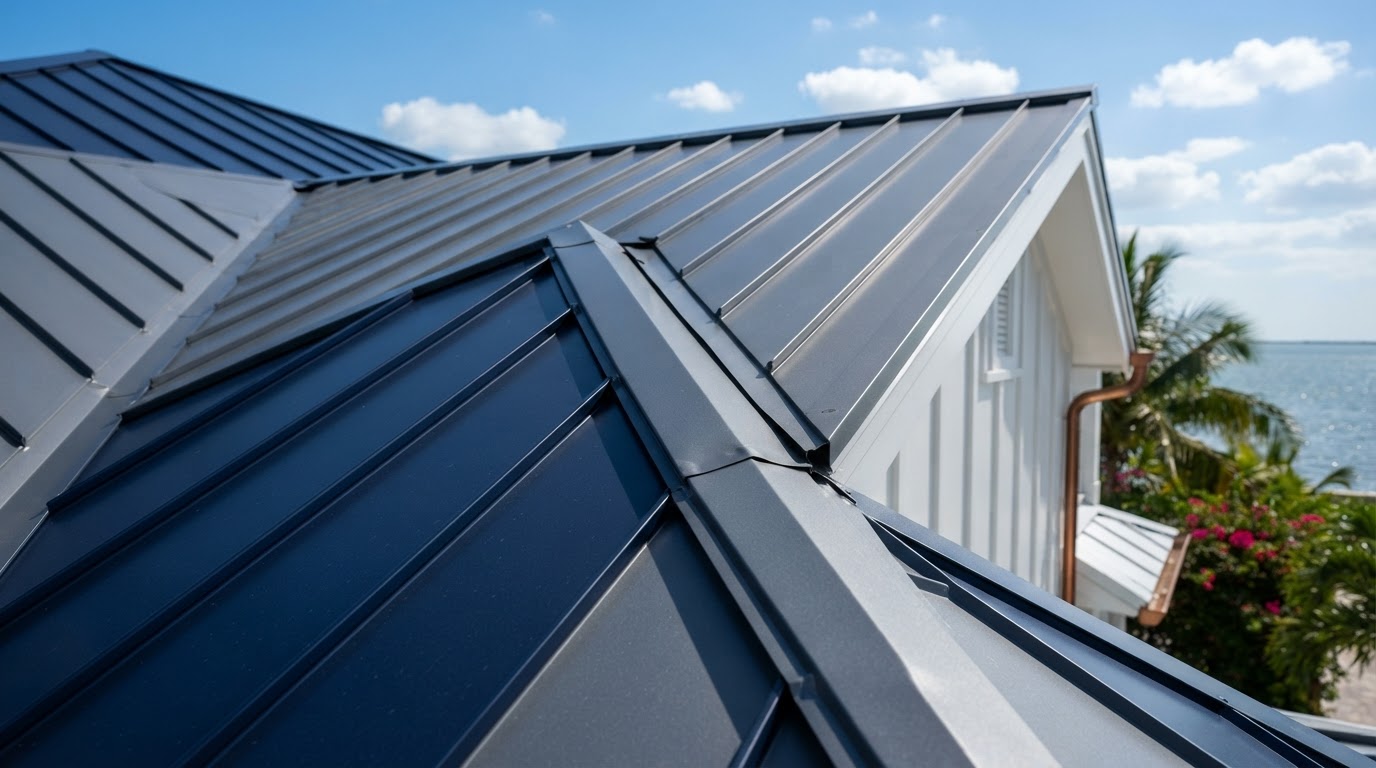
Standing seam uses a clip system that lets the panel expand and contract while keeping the fasteners concealed beneath the seam. 5V crimp is a traditional Florida profile with exposed screws that require periodic inspection—washers and seals age under Gulf Coast sun. R-panel is the workhorse of agricultural and light-commercial roofs, where the exposed-fastener pattern is designed for the building type. None of these is universally “best” for wind; the right system depends on the roof, the exposure, and the approved assembly.
Compare the systems in detail
The Parts of the Roof That Matter During High Winds
Wind does not load a roof evenly. Uplift concentrates at the edges, the corners, and the ridge—exactly the areas where a roof is most likely to fail first if the details are not right. The panel is only one layer of the story; the components that tie the roof together at its weakest geometric points are what keep it attached in a storm.
- Roof edges, eaves, and rakes—where wind first gets under the roof
- Corners—the highest uplift pressures on most roofs
- Ridge—the roof peak, vulnerable to both uplift and ridge-cap loss
- Flashing at penetrations, walls, and transitions
- Panel attachment—clip or fastener spacing and engagement
- Deck attachment—how well the substrate itself is fastened down
- Roof-to-wall connections—the structural tie that keeps the roof on the building
- Underlayment and a secondary water barrier beneath the metal
This is why a wind rating that only describes the panel misses the point. The ridge, the edges, the flashing, and the roof-to-wall connection are where storms do their damage. A properly specified roof addresses all of these as a system, not just the visible metal on top.
Related wind-resistance components
Choosing Metal Roofing for Pensacola
Pensacola sits on the western Florida Panhandle with direct Gulf exposure, and the wind demand on a roof here is not the same as an inland Florida roof. Barrier-island and coastal communities—Pensacola Beach, Perdido Key, Gulf Breeze, Navarre—face open exposure, salt deposition, and the full force of Gulf tropical systems. Escambia and Santa Rosa County homes inland still see major hurricane winds but with different edge and debris conditions.
That means the correct metal roof specification should consider the specific property—its exposure, height, geometry, and distance from open water—rather than applying a generic “Florida metal roof” specification to every house. A roof that is appropriate a few blocks inland may need different edge detailing, coating, or material selection on the coast.
- Gulf hurricanes and tropical storms—sustained winds plus surge-driven debris
- Coastal and open exposure—higher edge and corner pressures
- Pensacola Beach and Perdido Key—barrier-island wind and salt exposure
- Gulf Breeze and Navarre—near-shore conditions on the peninsula
- Escambia and Santa Rosa County—inland still subject to hurricane wind events
- Salt-air interaction with coatings, cut edges, and fastener materials
Specification factors for Gulf Coast metal roofing
Ask for Roofing-System Documentation Before Installation
A wind performance claim is only as good as the documentation behind it. Before any metal roof is installed, a homeowner can ask for the product approval or engineering documentation that covers the proposed assembly, and confirm that the planned installation matches the tested system—same panel, same clips or fasteners, same spacing, same edge details.
- The product approval or Notice of Acceptance for the proposed assembly
- The panel profile and gauge being proposed
- The clip or fastener type and spacing the approval is based on
- The underlayment and secondary water barrier in the assembly
- Edge and flashing details that match the tested condition
- Whether the installer is following the manufacturer's installation specifications
Florida product approvals and notices of acceptance are maintained by the state and can change. For current requirements, approved products, and valid approval status, verify through the relevant Florida building-code and product-approval resources before installation. A claim that a roof “can withstand” a specific wind speed is only meaningful if it is tied to a specific approved assembly.
Frequently Asked Questions
Compare Metal Roofing Systems for a Pensacola Home.
Contact Pensacola Metal & Shingle Roofing Contractors for a detailed written estimate across Pensacola, Escambia County, and Santa Rosa County.
Request Your Roofing Estimate
Direct consultation for Pensacola & Escambia County residential and coastal properties.