Metal Roof Repair Pensacola
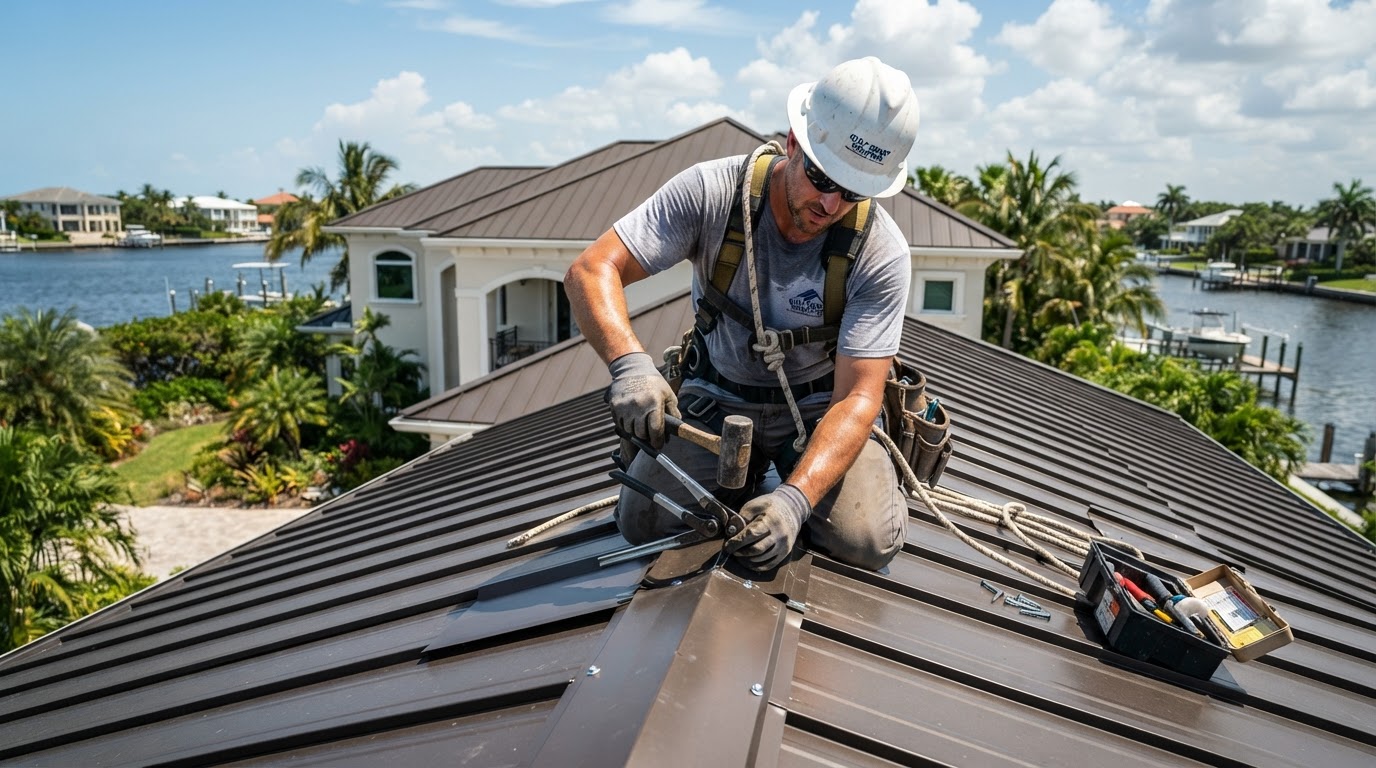
Metal roofing is durable, but it is not maintenance-free—and it fails in specific, predictable ways that depend entirely on the system. A standing seam roof leaks at seams and clips. A 5V crimp or R-panel roof leaks at exposed fasteners and washers. Repairing a metal roof means addressing the specific panel, seam, fastener, flashing, or coating failure, not applying a generic patch and hoping it holds. We repair all major metal roofing systems across Pensacola, Escambia County, and the western Florida Panhandle.
Metal roof repair depends heavily on the roofing system. A standing seam roof has different failure points from an exposed-fastener or 5V crimp roof, so repairs should address the specific panel, seam, fastener, flashing, or coating issue rather than relying on generic surface patching. The correct repair starts with identifying which metal system is on the roof and where that system's characteristic failure modes appear.
Metal Roof Problems We Evaluate
Metal roofs fail in recognizable patterns. Knowing what to look for—and where each failure mode tends to appear—turns a repair from a guess into a diagnosis. The warning signs below are the ones that most often precede a metal roof leak or visible deterioration.
- Loose fasteners and backed-out screws that expose the penetration to water
- Failed washers—cracked, compressed, or dried out from UV and heat exposure
- Panel damage—dents, creases, or displaced panels from storm impact or wind
- Open seams where adjacent panels have separated or clips have loosened
- Flashing failure at penetrations, walls, valleys, and transitions
- Penetration leaks around pipe boots, vents, and skylights
- Surface corrosion and rust, particularly around fasteners and cut edges
- Edge and ridge damage where wind pressure is highest
- Storm damage—wind, debris, and water intrusion from tropical systems
- Previous failed repairs—sealant or patching that concealed rather than corrected the problem
Repair by Metal Roof Type
Each metal roofing system has its own anatomy and its own failure points. A repair that is correct on one system can be wrong on another. The approach below is organized by system so the repair matches the roof that is actually on the house.
Standing Seam
Seam issues, clip and attachment considerations, flashing at penetrations, and panel damage. Concealed fasteners mean the field is not the usual leak source—seams, clips, and transitions are.
Standing Seam Metal Roofing5V Crimp
Exposed fasteners and washers, panel laps, and flashing. The fasteners are the primary maintenance item, and washer deterioration is the most common leak source.
5V Crimp Metal RoofingMetal Roof Screw & Fastener ReplacementR-Panel / Exposed Fastener
Screw patterns, panel laps, closures, and fastener deterioration. Large panel fields mean many fasteners, each a potential leak point as washers age.
R-Panel Metal RoofingMetal Roof Screw & Fastener ReplacementMetal Shingles & Stone-Coated
Individual component damage, flashing, and interlocking areas. Repairs target the affected piece or detail rather than a panel field.
Metal ShinglesStone-Coated Steel RoofingMetal Roof Leak Diagnosis
A metal roof leak is diagnosed by following the water to its entry point among the system's characteristic failure modes. The diagnostic process reviews fasteners, seams, penetrations, valleys, ridge details, wall transitions, and flashing—each a potential source—before concluding where the water is actually entering.
- Fasteners—loose, backed-out, or deteriorated screws and washers on exposed-fastener systems
- Seams—separated or damaged seams on standing seam panels where clips or seals have failed
- Roof penetrations—pipe boots, vents, and skylights whose flashing or seals have deteriorated
- Valleys—where two roof planes meet and concentrate water flow
- Ridge details—ventilation and cap components at the roof's most exposed line
- Wall transitions—flashing where the roof meets a vertical wall or parapet
- Flashing—loose, corroded, or improperly installed flashing at any transition
- Previous sealant repairs—patching that may have concealed rather than corrected the failure
- Corrosion—rust around fasteners and cut edges that has compromised the protective coating
Coating or sealant should not be used as a universal substitute for correcting failed roofing details. A coating applied over a loose fastener or failed flashing does not stop the leak beneath it; it conceals it. The failed detail must be corrected before any coating or restoration is considered, or the leak will recur beneath the coating.
Repair vs Restoration vs Replacement
Not every metal roof problem means replacement. Three levels of intervention address different conditions, and the right one depends on whether the roof has a localized defect, a broadly serviceable but weathered system, or widespread deterioration. Matching the intervention to the condition prevents both under-repairing and unnecessary replacement.
| Intervention | What It Addresses | When It Fits |
|---|---|---|
| Repair | A localized defect—a failed fastener, a damaged panel, a flashing leak | The roof is otherwise sound and the problem is isolated |
| Restoration | A broadly serviceable but weathered system—coating, rust treatment, fastener renewal | Panels are structurally viable and corrosion is manageable |
| Replacement | Widespread deterioration, significant corrosion, recurring leaks, or damaged panels | The system has failed broadly and repair is no longer economical |
Restoration and replacement options
Metal Roof Repair Near Pensacola's Coast
Pensacola's coastal environment accelerates specific metal roof failure modes. Salt-air deposition near the coast attacks coatings and fasteners faster than inland. Gulf humidity keeps surfaces damp, encouraging corrosion. UV breaks down exposed rubber washers and sealants. And tropical storms test every seam, fastener, and flashing at once. The repair approach along the coast accounts for these accelerants rather than treating a coastal roof like an inland one.
- Salt-air exposure that accelerates coating breakdown and fastener corrosion near the coast
- Gulf humidity that keeps surfaces damp and speeds corrosion of unprotected metal
- UV that cracks and degrades exposed rubber washers and sealants over time
- Thermal cycling from Florida heat that works fasteners loose over seasons
- Tropical storms that stress every seam, clip, and penetration simultaneously
- Wind uplift that targets edges, ridges, and inadequately fastened panels
Coastal metal roofing guides
Inspecting Metal Roofs After Hurricanes
A metal roof can survive a hurricane visibly intact and still have damage that will leak later. Wind can loosen fasteners without dislodging panels. Debris can dent a panel enough to compromise its water-shedding. And seams can shift under uplift without separating visibly. A post-storm inspection checks the specific failure modes metal roofs develop under wind, rather than relying on a visual once-over.
- Fastener check—screws loosened or backed out by wind cycling
- Seam inspection—standing seam panels shifted or clips stressed by uplift
- Panel assessment—dents or creases from debris impact that may compromise water shedding
- Flashing review—transitions and penetrations stressed by wind-driven rain
- Corrosion note—any freshly exposed metal from storm damage that needs protection
Post-storm metal roof resources
Frequently Asked Questions
Metal Roof Leak or Damage in Pensacola?
Contact Pensacola Metal & Shingle Roofing Contractors for a detailed written estimate across Pensacola, Escambia County, and Santa Rosa County.
Request Your Roofing Estimate
Direct consultation for Pensacola & Escambia County residential and coastal properties.