Metal Roof Screw & Fastener Replacement Pensacola
On an exposed-fastener metal roof, the screws and rubber washers are not hardware afterthoughts—they are part of the weather-resistant system. Every fastener penetrates the panel, and the washer beneath each screw head is what keeps water out of that penetration. As those washers age and screws work loose from Florida's thermal cycling, the roof's most common leak source develops. We replace loose, backed-out, and deteriorated fasteners on 5V crimp, R-panel, and similar exposed-fastener systems across Pensacola and Escambia County.
On exposed-fastener metal roofing, screws and sealing washers are part of the weather-resistant system. Over time, movement, UV exposure, compression changes, or improper installation can contribute to loose, backed-out, or deteriorated fasteners. When a washer cracks or a screw backs out, the penetration it was sealing becomes a leak point. Fastener replacement restores the seal at each penetration rather than coating over a failing one.
Why Metal Roof Screws Fail
Metal roof screws fail for identifiable reasons, most of which come down to movement, exposure, or installation. Understanding why a fastener fails tells you whether the fix is replacing that fastener, correcting an installation problem, or addressing a broader fastener field that is aging together.
- Thermal expansion and contraction—as the metal roof heats and cools, it moves, working fasteners loose over seasons
- Overdriven screws that compress the washer too far and crack it, losing the seal immediately
- Underdriven screws that do not compress the washer enough to seal against the panel
- Misaligned fasteners that miss the structural substrate and have poor engagement
- UV and weathering of washers—rubber and neoprene gaskets that crack and dry out from sun exposure
- Movement from wind uplift that stresses fasteners and accelerates loosening
- Age—washers that have simply reached the end of their service life from years of compression and exposure
- Improper substrate engagement—screws in decking that is too thin or deteriorated to hold securely
- Storm exposure that loosens marginal fasteners and exposes previously sealed penetrations
We do not imply every exposed screw needs replacement at a fixed age. Fastener condition varies with installation quality, roof orientation, sun exposure, and the specific washer material. Replacement is driven by observed condition, not a universal schedule.
Signs Fasteners Need Attention
Fastener failure leaves visible evidence if you know where to look. The signs below are what a fastener inspection reviews across the roof field, not just at one screw. A single backed-out screw is often a signal that others are approaching the same condition, because fasteners installed together tend to age together.
- Backed-out screws—fastener heads visibly raised above the panel surface
- Missing screws—fasteners that have backed out entirely and left an open penetration
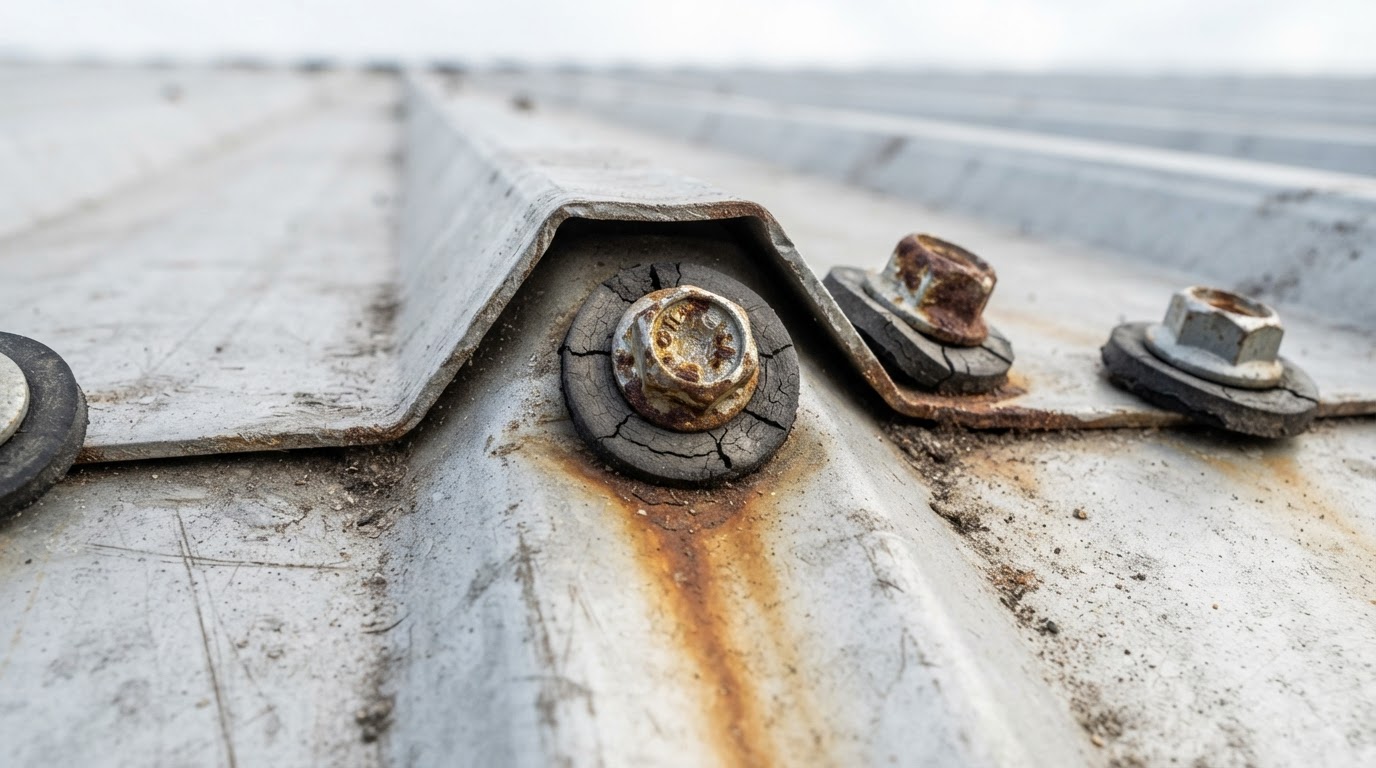
- Cracked or deteriorated washers—rubber gaskets split, dried, or pulled away from the screw head
- Water staining beneath fastener lines—discoloration on the underside of panels along screw rows
- Rust around screws—corrosion at the penetration that indicates the protective coating has failed there
- Loose panels—metal that flexes or rattles because fasteners no longer hold it securely
- Repeated sealant patches—evidence that leaks at fasteners have been patched rather than corrected
Symptoms should be assessed across the roofing system, not just at one screw. A single failed fastener may indicate that a field of fasteners installed at the same time is approaching the same condition. Evaluating the pattern—scattered or widespread—determines whether isolated replacement or a broader fastener program is appropriate.
Refastening vs Complete Fastener Replacement
Fastener repair is not a single approach. The scope depends on how many fasteners have failed, the pattern of failure, and the condition of the substrate beneath them. The options below represent the conceptual choices, each appropriate to a different condition.
- Replace isolated failed fasteners—target individual screws and washers that have backed out or failed while the field remains sound
- Address larger fastener fields—replace a broader set when the pattern of failure is widespread rather than scattered
- Use appropriately specified replacement fasteners—matched to the panel profile, substrate, and exposure conditions
- Evaluate substrate condition—confirm the decking or framing beneath can hold the replacement fastener securely
- Correct stripped or oversized holes appropriately based on the roofing system—whether by relocation, repair, or panel-specific methods
We do not prescribe universal screw sizes or engineering specifications. The correct replacement fastener depends on the panel profile, gauge, substrate material and thickness, and exposure conditions. A fastener that is right for one roof may be wrong for another, which is why replacement is specified to the system rather than chosen generically.
Exposed Fastener Roofs Near Pensacola
Pensacola's climate accelerates fastener failure in specific ways. UV is the primary enemy of rubber and neoprene washers—it cracks and dries them over years of direct sun. Heat cycling works screws loose as the metal expands and contracts. Heavy rain tests every washer at once. Gulf humidity keeps surfaces damp. And salt exposure nearer the coast accelerates corrosion at any penetration where the coating has been compromised. Regular visual inspection catches fastener deterioration before it becomes a leak.
- UV—the primary cause of washer deterioration, cracking rubber and neoprene gaskets exposed to direct sun
- Heat cycling—daily expansion and contraction that works fasteners loose over seasons
- Heavy rain that tests every washer simultaneously and finds the weakest seal
- Wind that stresses fasteners and accelerates loosening of marginal screws
- Gulf humidity that keeps surfaces damp and slows drying of any moisture at penetrations
- Salt exposure nearer the coast that accelerates corrosion at fasteners where coating has failed
- Regular visual inspection—the most effective way to catch fastener deterioration before it leaks
Related exposed-fastener services
How Failed Fasteners Become Leaks
The path from a failed fastener to an interior leak is direct. A washer cracks or a screw backs out, and the penetration it was sealing opens to water. Rain that previously shed over the sealed fastener now enters at the gap. The water runs down the underside of the panel, reaches the deck, and follows the structure until it appears inside as a stain or drip—often far from the actual fastener that failed.
- 1A washer deteriorates or a screw backs out, opening the penetration it sealed
- 2Rain that previously shed over the sealed fastener now enters at the open gap
- 3Water runs along the underside of the panel and reaches the roof deck
- 4The water follows the structure and appears inside as a stain or drip, often far from the source
- 5Because the stain is distant from the fastener, the leak is easily misdiagnosed without inspection
This is why a fastener-line leak is often misdiagnosed as a flashing or seam problem. The water appears at a point far from the actual failed screw, and without inspecting the fastener field, the wrong repair is attempted. A fastener inspection checks the screw rows as a primary leak source on exposed-fastener roofs.
When Fastener Failure Justifies Reroofing
Fastener replacement is a repair, not a permanent solution to a roof that has reached end-of-life. There comes a point where replacing fasteners on a roof with widespread panel corrosion, deteriorated coatings, or structural panel damage is no longer economical, and reroofing becomes the better investment. Knowing where that line falls depends on the overall condition of the metal panels, not just the fasteners.
- Scattered fastener failure on otherwise sound panels—fastener replacement is appropriate
- Widespread fastener failure across the field—a broader fastener program may be warranted
- Fastener failure combined with panel corrosion—repair may only defer the inevitable
- Fastener failure with deteriorated coatings and structural panel damage—reroofing is likely the better option
- The decision depends on the overall panel condition, not the fasteners alone
If reroofing is the better option
Frequently Asked Questions
Loose or Leaking Metal Roof Screws in Pensacola?
Contact Pensacola Metal & Shingle Roofing Contractors for a detailed written estimate across Pensacola, Escambia County, and Santa Rosa County.
Request Your Roofing Estimate
Direct consultation for Pensacola & Escambia County residential and coastal properties.