Metal Roof Coating & Rust Restoration Pensacola
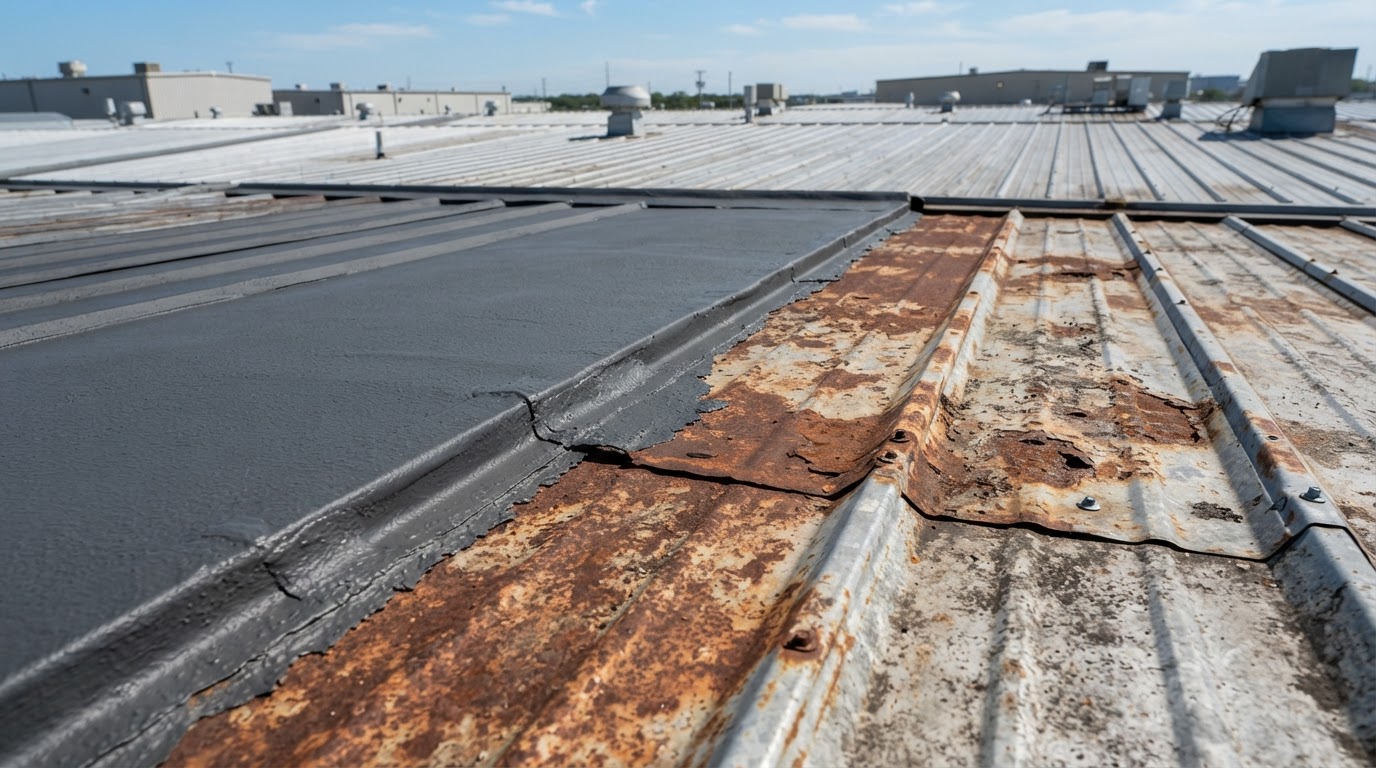
A weathered metal roof is not always a roof that needs replacing. Oxidation, faded coatings, and surface rust can often be treated and the roof restored—when the panels beneath are still structurally sound. The key is honest evaluation: coating is not a cure for structural damage, severe corrosion, failed panels, or underlying leaks. We evaluate weathered metal roofing across Pensacola, Escambia County, and the coastal communities of Pensacola Beach, Perdido Key, Gulf Breeze, and Navarre to determine whether restoration is viable or replacement is the better path.
Some weathered metal roofing systems may be candidates for repair or restoration, but coating is not a cure for every metal roof problem. Structural damage, severe corrosion, failed panels, compromised seams, or underlying leaks must be addressed before a coating system is considered. A restoration candidate is a roof whose panels are structurally viable and whose corrosion is manageable; a poor candidate has deterioration too deep for a surface treatment to correct.
What Causes Metal Roof Corrosion?
Metal roof corrosion has specific causes, and understanding them tells you whether the rust you see is a surface issue or a sign of deeper failure. Most corrosion starts where the protective coating has been compromised and moisture or salt reaches the bare metal beneath.
- Damaged protective coatings—scratches, abrasions, or factory coating breakdown that expose bare metal
- Long-term moisture—standing water or debris that keeps the surface damp and accelerates corrosion
- Salt-air exposure—coastal salt deposition that attacks metal and coatings faster than inland conditions
- Dissimilar metal interaction generally—contact between incompatible metals that can accelerate corrosion at the junction
- Scratches and cut edges—unprotected cut ends where the coating does not wrap the metal
- Standing debris—leaves and dirt that trap moisture against the panel surface
- Fastener deterioration—rust at screws and washers where the coating has been pierced
- Age—coatings that have simply weathered past their service life from years of sun and rain
- Improper prior repairs—patching or sealant that trapped moisture rather than excluding it
We do not claim all discoloration equals severe structural corrosion. Surface oxidation and faded coatings can be cosmetic or manageable, while pitting and perforation indicate deeper failure. The distinction matters because a surface-issue roof may restore well, while a structurally compromised roof will not.
When Can a Metal Roof Be Restored?
Restoration is viable for some weathered roofs and not for others. The decision depends on whether the panels are structurally sound and whether the corrosion is manageable. A roof that looks weathered but is fundamentally serviceable is a restoration candidate; a roof with deep structural failure is not.
| Good Restoration Candidate | Poor Restoration Candidate |
|---|---|
| Roof remains fundamentally serviceable | Extensive panel perforation from corrosion |
| Corrosion is surface-level and manageable | Severe panel deterioration or structural loss |
| Panels are structurally viable | Major structural problems in the roof assembly |
| Leaks can be repaired at their source first | Widespread substrate failure beneath the roofing |
| Fasteners and seams can be corrected | Replacement is already required by overall condition |
| Substrate is suitable for the selected coating system | Underlying leaks have caused deck damage |
Leaks must be repaired before any coating is applied. A coating applied over an active leak seals the surface but not the leak beneath it, and the water continues to enter and damage the deck hidden from view. Coating follows repair; it does not substitute for it.
Coating Is Not the Same as Paint
A roof coating system is not a can of paint. It is a roofing-specific process that prepares the surface, treats corrosion, repairs failed details, and applies a coating engineered for roof exposure. Skipping the preparation and repair steps turns a coating into paint—and paint on a roof does not last and does not restore the weatherproofing.
- 1Roof preparation—cleaning the surface, removing debris, and assessing the condition of panels and fasteners
- 2Cleaning—removing dirt, oxidation, and loose material so the coating can bond to a sound surface
- 3Rust treatment where appropriate—treating corroded areas to slow further oxidation before coating
- 4Repair before coating—correcting failed fasteners, seams, and flashing so the roof is weathertight
- 5Primer compatibility—using a primer suited to the metal substrate and the selected coating system
- 6Roofing-specific coating systems—applying a coating engineered for roof exposure, not a generic paint
- 7Seam and fastener preparation—detailing the most vulnerable points before the field coating goes on
- 8Application requirements—following the coating manufacturer's process for the system to perform as intended
We do not specify one coating chemistry as universally best. The appropriate coating depends on the metal substrate, the roof's condition, the exposure environment, and the manufacturer's system requirements. A coating that performs on one roof may be unsuitable for another, which is why the coating is matched to the specific roof rather than chosen generically.
Salt Air & Metal Roofing Near the Gulf
Coastal exposure near Pensacola accelerates metal roof corrosion in ways inland roofs do not face. Salt deposition from Gulf air settles on surfaces and attacks coatings and bare metal. The closer a roof is to the water—Pensacola Beach, Perdido Key, Gulf Breeze, Navarre—the more aggressive the corrosion environment. Restoration and maintenance along the coast must account for that exposure rather than treating a coastal roof like an inland one.
- Salt deposition from Gulf air that settles on surfaces and attacks coatings and metal
- Coastal exposure that accelerates corrosion the closer a roof is to the water
- Maintenance that must be more frequent along the coast to keep ahead of corrosion
- Finish selection—coatings and substrates chosen for salt-air performance, not just appearance
- Cut-edge protection—sealing exposed cut ends where salt can attack unprotected metal
- Fastener and material compatibility—using metals and coatings that do not create corrosive interactions
Coastal metal roofing guides
Repair Before You Coat
The single most common reason a metal roof coating fails is that it was applied over unrepaired damage. A coating seals the surface, but it does not fix a loose fastener, an open seam, or an active leak beneath it. When those problems remain, the coating conceals them while the damage continues underneath—often worse, because it is no longer visible. The correct sequence is repair first, coating second.
- Fasteners replaced or resealed before coating so the field is sound
- Seams corrected so the coating bridges a weathertight joint, not a gap
- Flashing repaired at penetrations and transitions before the coating goes on
- Active leaks diagnosed and repaired at their source, not coated over
- Surface corrosion treated so the coating bonds to stable metal, not rust
- Deck damage addressed where it exists before any surface treatment
Repairs that precede a coating
Restoration vs Replacement
The most important question about a weathered metal roof is whether restoration is honest or whether it delays an inevitable replacement. Restoration makes sense when the panels are structurally viable and the corrosion is manageable. Replacement is the better answer when corrosion has gone too deep, panels are perforated, or the system has broader failures that a surface treatment cannot correct. Choosing restoration when replacement is warranted wastes money on a coating that cannot save the roof.
- Restoration fits when panels are structurally sound and corrosion is manageable
- Replacement fits when corrosion has caused perforation or structural panel loss
- Restoration fits when leaks can be repaired at their source first
- Replacement fits when leaks are widespread and the system is failing broadly
- Restoration is an investment in extending a serviceable roof's life
- Replacement is an investment in a new roof when the current one cannot be saved
If replacement is the better path
Frequently Asked Questions
Weathered or Rusted Metal Roof in Pensacola?
Contact Pensacola Metal & Shingle Roofing Contractors for a detailed written estimate across Pensacola, Escambia County, and Santa Rosa County.
Request Your Roofing Estimate
Direct consultation for Pensacola & Escambia County residential and coastal properties.