
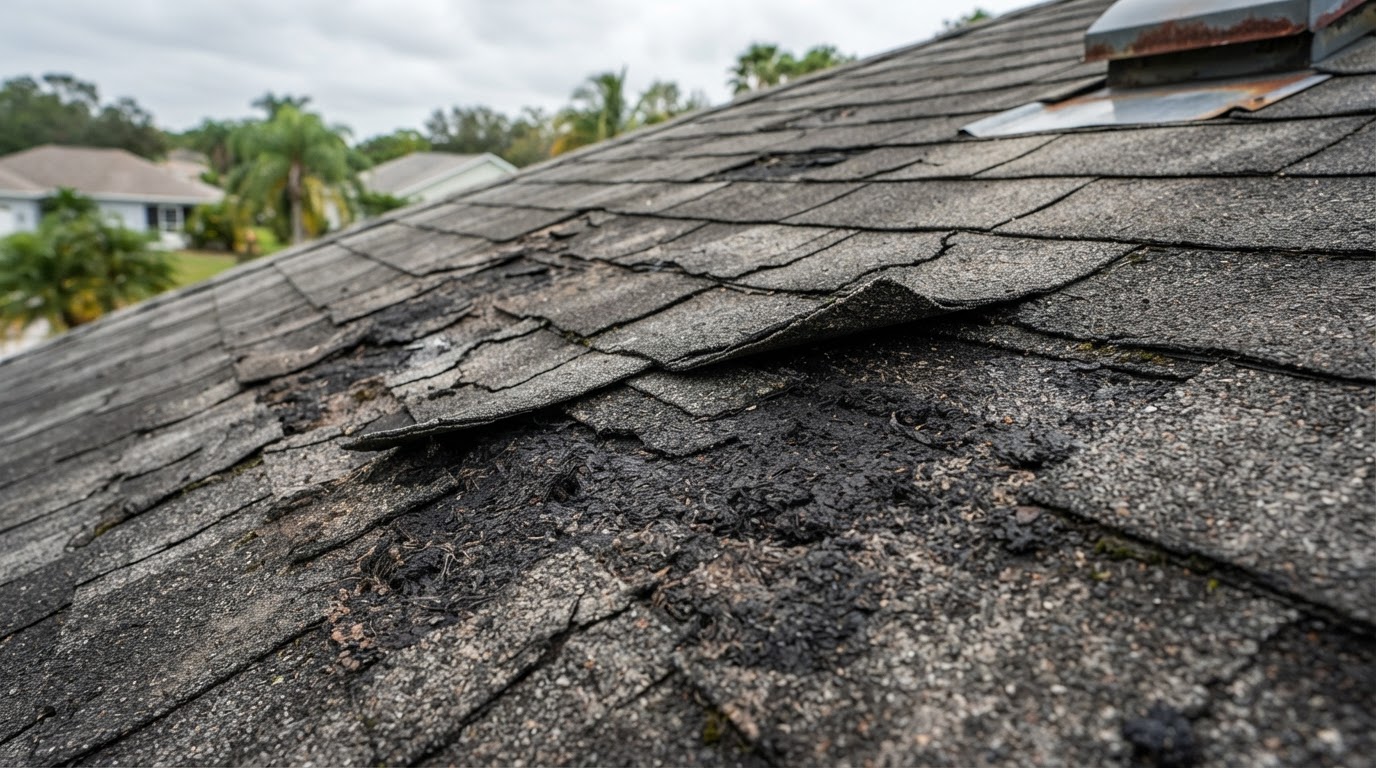
Cracked, Curling & Granule-Loss Shingle Repair Pensacola
Cracking, curling, and excessive granule loss are the three visible symptoms homeowners notice first as an asphalt shingle roof ages in Pensacola's climate. Each symptom can have a different cause, and none of them automatically means the entire roof requires replacement. Sometimes a localized repair restores the roof's integrity; other times the pattern of deterioration points toward reroofing. We diagnose the specific condition behind the visible wear and tell you honestly whether a repair is sound or replacement is the more economical path.
Cracked, curling, and granule-loss shingle repair addresses the three most common visible signs of asphalt shingle deterioration. Cracking results from UV drying and thermal cycling; curling from heat, moisture, and ventilation issues; granule loss from normal aging or excessive wear that exposes the asphalt mat. Whether these symptoms justify repair or full replacement depends on how widespread the damage is, whether the deck remains sound, and whether the roof still has useful service life. A targeted repair can extend a serviceable roof; widespread deterioration usually points to replacement.
What Each Type of Shingle Damage Means
Cracking, curling, and granule loss are distinct failure modes with different underlying causes. Treating them as a single problem leads to repairs that do not address the real issue. We evaluate each symptom separately to determine whether the cause is isolated damage, systemic aging, or an installation and ventilation problem that will recur even after a repair.
Cracked shingles develop when the asphalt base loses flexibility through UV exposure and repeated thermal cycling. Pensacola's intense sun heats the roof surface during the day and cools it at night, and that expansion-and-contraction cycle stresses the shingle until hairline cracks form and widen over time. Wind adds mechanical stress that can turn a surface crack into a crease or a split.
Curling shingles bend upward at the edges or corners when the shingle's underside dries and shrinks faster than the top, or when poor attic ventilation traps heat and moisture beneath the deck. A shingle that curls exposes its lower edge to wind-driven rain and weakens the seal strip that holds it flat. Curling is often a sign of a ventilation or installation issue as much as simple aging.
Granule loss is normal in small amounts, but excessive loss exposes the asphalt mat to UV and accelerates deterioration. Granules are the shingle's protective surface, and when they shed heavily into the gutters, the shingle loses its weather resistance. Some granule loss is expected as a roof ages; the question is whether the loss is normal wear or a sign that the shingle has reached the end of its service life.
These symptoms can have overlapping causes, and a visual inspection from the ground is not sufficient to diagnose them accurately. We inspect the roof surface, the flashing, the deck condition where accessible, and the attic ventilation before recommending repair or replacement.
Can Damaged Shingles Be Repaired?
Isolated shingle damage on an otherwise serviceable roof is often repairable. The decision hinges on how much of the roof is affected, whether compatible replacement material is available, and whether the underlying deck is still sound. A small patch of cracked or curled shingles on a roof with years of remaining life is a good repair candidate. Widespread deterioration across multiple roof planes usually points the other direction.
Repair may make sense when the damage is confined to a small area, compatible replacement shingles are available, the rest of the roof is still serviceable, the deck beneath remains solid, and there is no widespread pattern of the same failure elsewhere on the roof.
- Small affected area—localized cracking or curling on one roof plane
- Compatible replacement material—a matching shingle is still available
- Roof otherwise serviceable—the rest of the roof has useful life remaining
- Deck remains sound—no softness or rot beneath the damaged shingles
- No widespread failure—the same symptom is not appearing across the roof
Repair becomes less practical when damage is widespread rather than isolated. Large-scale curling across multiple roof planes, granule loss visible over most of the roof, numerous cracked tabs scattered across different sections, repeated leaks in different areas, or an aging roof near the end of its service life all suggest that targeted repairs will only delay an inevitable replacement. Discontinued or mismatched shingles also make repair less attractive, since a visible patch can look worse than the original damage.
- Large-scale curling—shingles curling across multiple roof planes
- Widespread granule loss—exposed mat visible over most of the roof
- Numerous cracked tabs—cracks scattered across different sections
- Repeated leaks—water intrusion in multiple areas
- Aging roof—the roof is near the end of its expected service life
- Discontinued or mismatched shingles—a clean repair match is not possible
Related repair and replacement options
Pensacola Weather & Shingle Deterioration
Pensacola's climate accelerates the three deterioration modes in specific ways. Understanding how Gulf Coast exposure interacts with asphalt shingles explains why these symptoms appear earlier here than in a milder climate and why a roof that looks fine in spring can show significant wear by the end of hurricane season.
- UV exposure—intense Florida sun dries the asphalt base and drives cracking
- Florida heat—high surface temperatures stress the shingle and accelerate aging
- Humidity—moisture contributes to curling and feeds algae that darkens the surface
- Heavy rainfall—repeated wetting tests flashings and underlayment
- Wind—mechanical stress that creases, lifts, and tears shingles
- Tropical weather—storm events that concentrate a season of wear into hours
- Algae and moisture conditions—dark streaking and surface dampness that age shingles
These forces do not act alone. UV and heat work together to dry and crack the asphalt; humidity and shade combine to feed algae; wind and rain team up during storms to test every weak point. A shingle roof in Pensacola faces a combined exposure that no single factor fully explains, which is why the same shingle installed in a cooler, drier climate ages more slowly than one on the Gulf Coast.
Inspection & Repair Process
A shingle damage repair starts with understanding what caused the visible symptom and whether the surrounding roof is sound. We do not patch a cracked shingle without checking whether the deck beneath is solid, and we do not replace a curled shingle without evaluating whether a ventilation problem will curl the replacement too. The process is diagnostic first, then corrective.
- 1Visual roof inspection—assess the type, extent, and location of visible damage
- 2Identify affected areas—map where cracking, curling, or granule loss is concentrated
- 3Check flashing and penetrations—look for related failures at valleys, vents, and edges
- 4Evaluate deck condition—check for softness or rot beneath damaged shingles where accessible
- 5Determine repair vs replacement—recommend the path that fits the roof's overall condition
- 6Match replacement shingles—source the closest available match when repair is appropriate
- 7Complete localized repair—replace damaged shingles with proper fastening and sealing
- 8Recheck vulnerable areas—verify adjacent shingles and flashing are intact
Connected services
When to Have Weathered Shingles Inspected
Weathered shingles should be inspected before they become leaking shingles. The visible symptoms of deterioration—cracking, curling, and granule loss—often appear well before water actually enters the house. Inspecting when you first notice these signs, rather than waiting for a leak, gives you the widest range of options: a repair may still be practical, and you avoid the secondary damage that a leaking roof causes to decking, insulation, and interiors.
The most useful times to schedule an inspection are before hurricane season, after a significant storm or wind event, when you first notice visible deterioration, and before listing a home for sale. Each of these moments is when undetected damage is most likely to become an expensive problem, and early diagnosis keeps your options open.
- Before hurricane season—identify and repair weak points before storms test them
- After a significant storm—catch wind and impact damage before water intrusion
- When you first notice visible deterioration—act before a symptom becomes a leak
- Before listing a home for sale—address issues before an inspection or buyer flags them
We do not claim that early inspection prevents all storm damage. The value of inspection is identifying repairable issues before they worsen and giving you accurate information about your roof's condition—so you can decide on repair or replacement with the facts in hand.
Frequently Asked Questions
Seeing Cracked, Curling, or Granule-Loss Shingles in Pensacola?
Contact Pensacola Metal & Shingle Roofing Contractors for a detailed written estimate across Pensacola, Escambia County, and Santa Rosa County.
Request Your Roofing Estimate
Direct consultation for Pensacola & Escambia County residential and coastal properties.