Roof Deck & Plywood Replacement Pensacola
The roof deck is the structural surface beneath every shingle and metal panel—the plywood or oriented strand board sheathing that fastens to the rafters and carries the roofing system. When long-term leaks, storm damage, or poor ventilation rot that decking, no new roof installed over it will perform correctly. We replace damaged roof deck sections during reroofing across Pensacola and Escambia County, removing compromised sheathing and installing solid material that gives the new roofing system a sound foundation.
Roof deck and plywood replacement removes rotten, soft, or deteriorated structural sheathing beneath a roofing system and installs new decking in its place. Damaged decking often cannot be confirmed until the existing roof covering is removed during tear-off, which is why deck inspection is a standard part of reroofing. Installing new shingles or metal roofing over rotten plywood risks fastener failure, sagging, and leaks, because the fasteners that hold the roof have nothing solid to grip.
Signs of Damaged Roof Decking
Roof deck damage reveals itself through both visible and hidden symptoms. Some signs are apparent from inside the attic or beneath the roof; others only become clear once the existing shingles or metal panels are removed. Because the deck sits beneath the roofing system, a portion of deck damage is always discovered during tear-off rather than diagnosed beforehand.
- Soft or spongy roof areas—decking that flexes underfoot during an inspection
- Sagging—visible dips or waves in the roof plane that suggest deck weakness
- Chronic leaks—repeated water intrusion that has saturated the sheathing over time
- Water staining—brown or dark marks on the underside of the deck in the attic
- Rot—wood that is crumbling, soft, or visibly decayed
- Delamination—plywood layers separating and peeling apart from moisture
- Mold and moisture evidence—growth or dampness indicating trapped water
- Loose fasteners—nails or screws that no longer grip because the wood is degraded
- Deterioration around penetrations—rot concentrated near vents, chimneys, and pipes
Some deck damage cannot be confirmed until the roof covering is removed. A roof may look intact from the surface while the plywood beneath is soft or rotted, which is why deck inspection during tear-off is a standard part of reroofing rather than an optional add-on.
What Causes Plywood & Deck Damage
Roof decking fails when it is exposed to moisture over time. The most common cause is a slow, long-term leak that saturates the plywood before it ever becomes visible inside the house. By the time water appears on a ceiling, the deck above may already be compromised. Understanding the sources of that moisture helps explain why deck replacement is so often paired with leak repair and reroofing.
- Long-term roof leaks—slow water intrusion that saturates the deck over months or years
- Failed flashing—water entering at walls, valleys, and penetrations that reaches the deck
- Missing shingles—exposed underlayment and deck directly to the elements
- Damaged underlayment—a compromised moisture barrier that lets water reach the sheathing
- Poor ventilation—trapped attic heat and moisture that condense on the deck underside
- Condensation—moisture forming on cool deck surfaces in a poorly ventilated attic
- Storm damage—wind, debris, and impact that puncture or weaken the deck
- Plumbing and HVAC penetrations—leaks at pipe boots and vent flashing that reach the deck
- Previous improper repairs—patches that trapped moisture rather than correcting it
Related services that protect the deck
Deck Repair During Roof Replacement
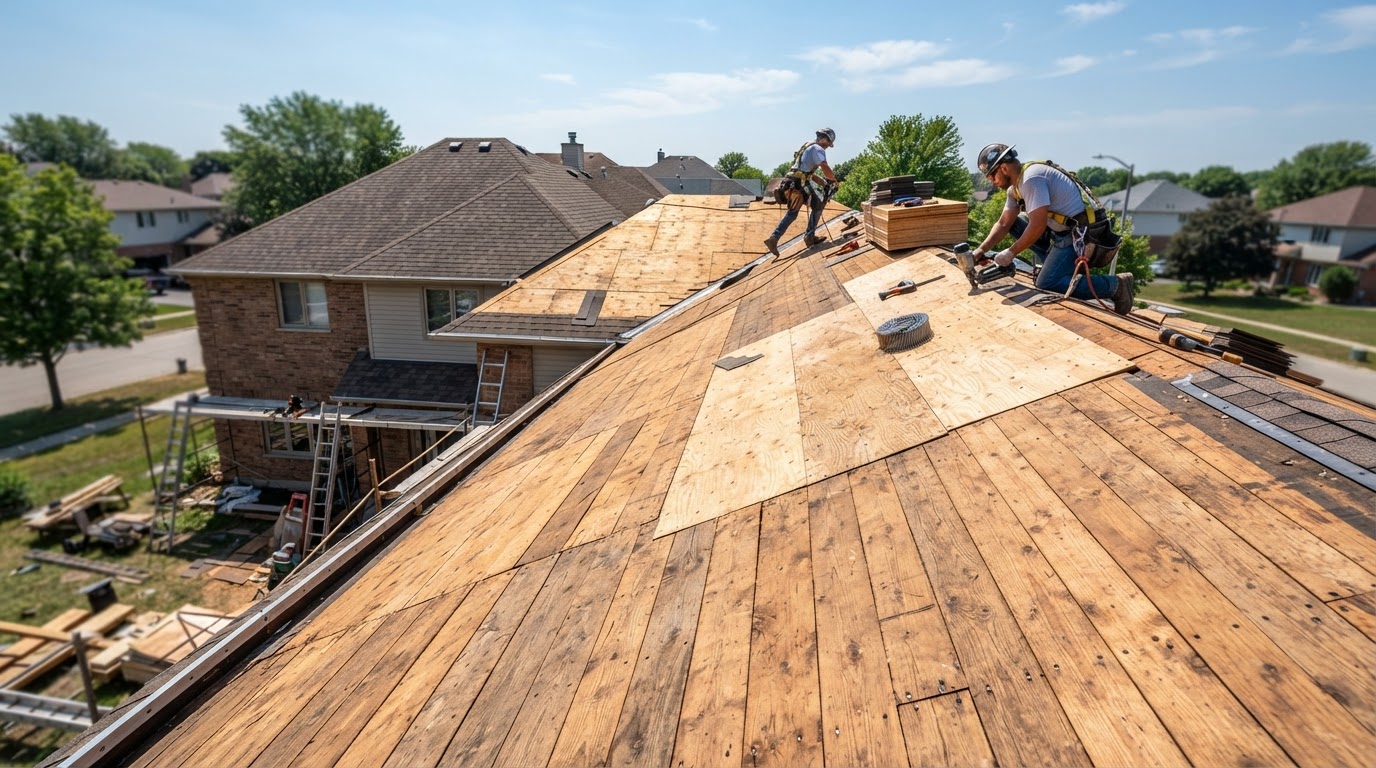
Deck replacement is almost always performed as part of a larger reroofing project, because the existing roof covering must be removed to access and evaluate the sheathing. Once the old shingles or metal and underlayment are off, every section of deck is inspected for soundness. Soft, rotted, or delaminated sections are cut out and replaced with new decking before any new roofing material is installed.
The reason damaged deck sections are not simply covered is structural: the fasteners that hold shingles and metal roofing grip into the deck. If the plywood is soft or rotten, those fasteners have nothing solid to hold, and the new roof can lift in wind, sag under weight, or leak at fasteners that pull out. Installing a new roof over compromised decking transfers the old problem into the new system.
- 1Tear-off—remove existing shingles or metal and underlayment to expose the deck
- 2Deck inspection—walk and probe every section for softness, rot, and delamination
- 3Mark damaged sections—identify plywood that must be replaced
- 4Removal of compromised material—cut out rotted or soft sheathing to the rafters
- 5Replacement with appropriate decking—install new plywood or OSB of the correct thickness
- 6Fastening considerations—secure new decking to the rafters with proper fasteners
- 7Preparation for underlayment—ensure a flat, solid surface for the moisture barrier
- 8Roofing system installation—proceed with underlayment, flashing, and the new roof covering
We do not provide structural engineering instructions or assess rafter and truss structural capacity. Deck replacement addresses the sheathing surface that the roofing system fastens to. If an inspection reveals structural framing damage beyond the decking, we identify it and recommend the appropriate next step.
Pensacola Moisture & Storm Considerations
Pensacola's combination of Gulf humidity, heavy rain, and hurricane exposure makes roof deck damage more common here than in drier climates. Wind-driven rain forces water beneath flashings and shingles where it can reach the deck. Repeated storm exposure tests every penetration and seam. And the humidity that defines the Gulf Coast means that any moisture that reaches the deck dries slowly, giving rot more time to take hold.
- Wind-driven rain—water forced beneath flashings that reaches the deck
- Gulf humidity—slow drying that lets moisture linger in the sheathing
- Repeated storm exposure—multiple events that stress flashings and penetrations
- Hidden moisture—water that saturates the deck before it appears inside
- Attic ventilation—poor airflow that traps heat and condensation against the deck
- Roof leaks after hurricanes and tropical storms—storm-driven water intrusion
This is why early leak repair matters so much in Pensacola. A leak that is addressed promptly may only damage the underlayment; the same leak ignored for months can rot the plywood beneath it. Repairing leaks before they reach the deck reduces the risk of more extensive and expensive deck deterioration—and keeps a reroofing project limited to the roof covering rather than expanding into structural sheathing.
When Deck Damage Is Discovered During Tear-Off
Because some deck damage is hidden until the roof covering is removed, it is common to discover rotted or soft plywood during a tear-off that was not visible beforehand. This is not unusual on older Pensacola roofs, and it is exactly why deck inspection is built into the reroofing process. The discovery is not a surprise to the process—it is the process working as intended.
When damaged decking is found, the affected sections are replaced before the new roofing system is installed. The scope and cost of deck replacement depends on how much plywood needs to be replaced, which is determined during tear-off. We communicate what is found so you understand the condition of the deck beneath your new roof.
- Damage hidden beneath the surface—not all rot is visible before tear-off
- Inspection during tear-off—a standard step, not an unexpected complication
- Replacement before roofing—new decking installed before the new roof goes on
- Scope communicated clearly—so you understand what was found and replaced
Connected reroofing services
Frequently Asked Questions
Concerned About Rotten or Damaged Roof Decking in Pensacola?
Contact Pensacola Metal & Shingle Roofing Contractors for a detailed written estimate across Pensacola, Escambia County, and Santa Rosa County.
Request Your Roofing Estimate
Direct consultation for Pensacola & Escambia County residential and coastal properties.