Missing & Lifted Shingle Repair After High Winds Pensacola
High winds do not need to blow shingles off the roof to damage them. Wind lifts tabs, creases shingles back at the fastener line, breaks adhesive seals, and cracks shingles around fasteners—all while the roof may still look mostly intact from the ground. We diagnose and repair wind-damaged shingle roofs across Pensacola, Escambia County, and the western Florida Panhandle after storms, hurricanes, and severe thunderstorms.
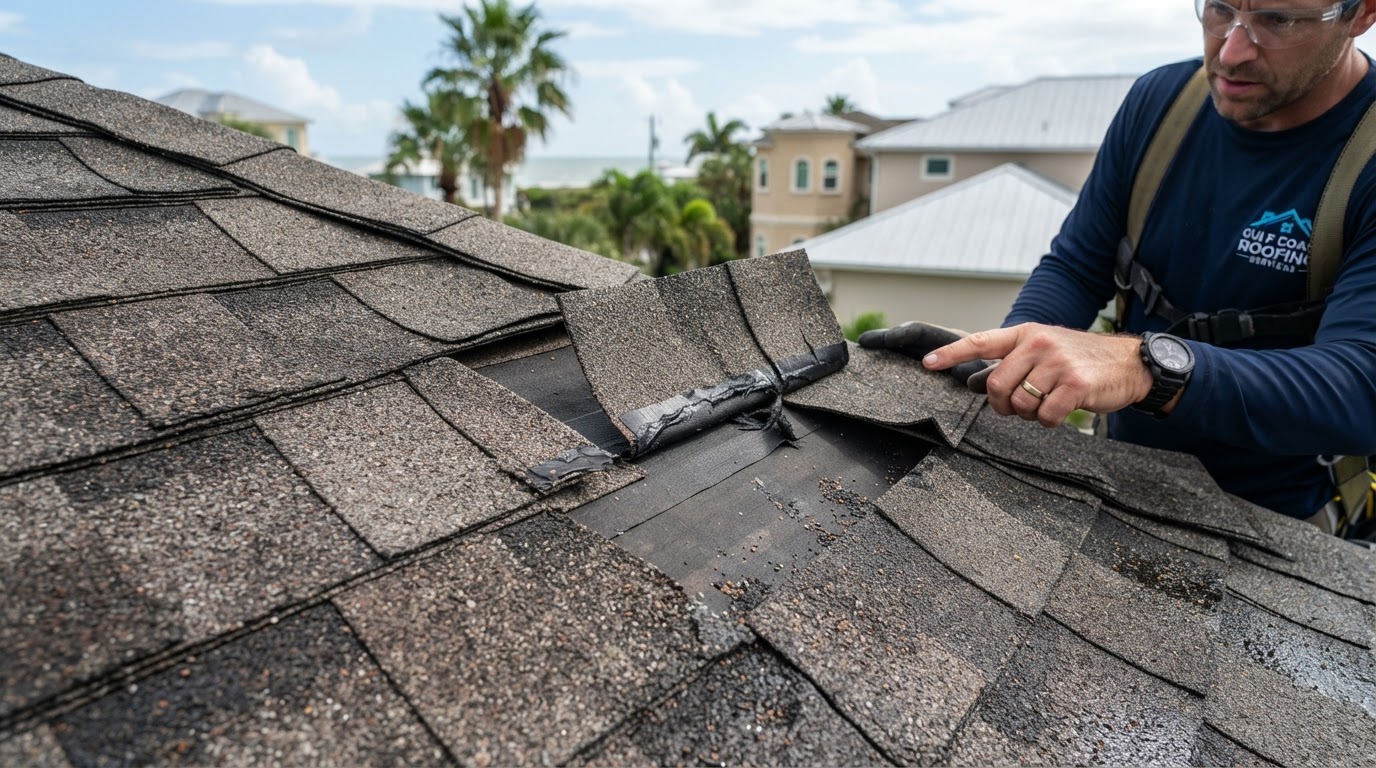
High winds do not need to completely remove a shingle to damage it. Shingles can lift, crease, break their adhesive seal, crack around fasteners, or loosen along roof edges while still appearing mostly intact from the ground. A creased shingle folded back at the fastener line has lost its seal and will leak under the next wind-driven rain, even if it sits flat again. Lifted shingles may not reseal correctly after substantial wind damage, which is why wind-damaged shingles often need replacement rather than simply being pressed back down.
How Wind Damages Shingles
Wind damages shingles through uplift—the same force that lifts an airplane wing. As wind flows over the roof, it creates negative pressure above the shingles that pulls them upward. The tabs lift, the adhesive seal stretches or breaks, and the shingle either creases back at the fastener line or tears away entirely. The damage is worst at the roof edges and ridges where wind pressure is highest.
- Uplift—negative pressure above the shingle that pulls tabs upward
- Broken adhesive seals—the factory seal strip that holds tabs down fails
- Creased tabs—shingles folded back at the fastener line and cracked
- Missing shingles—tabs or full shingles torn away by wind
- Edge and rake exposure—roof perimeter shingles lifted where wind hits first
- Ridge-cap damage—the roof peak is the most wind-exposed area on the roof
- Fastener stress—wind vibration stresses the nails holding shingles down
- Wind-driven rain—water forced beneath lifted tabs and broken seals
Lifted shingles may not simply reseal correctly after substantial wind damage. Once the factory seal strip has broken or the shingle has creased, pressing it back down does not restore the original bond. A creased or seal-broken shingle typically needs replacement, not just reseating.
What Damage Can Look Like From the Ground
Some wind damage is obvious—bare patches where shingles are missing, ridge caps on the lawn. But much of it is subtle and only visible from the roof surface. The warning signs below are what a homeowner can often see from the ground or a safe vantage point, and any of them warrants a professional inspection.
- Bare roof areas where shingles are missing and the underlayment is exposed
- Misaligned shingles—tabs that have shifted out of their pattern
- Raised corners or lifted tabs visible at the roof edge or on the slope
- Missing ridge caps along the roof peak
- Shingle debris on the lawn, in gutters, or against the house after a wind event
- Exposed underlayment visible where shingles have lifted away
- New ceiling stains or interior leaks after a wind storm
Do not climb onto a storm-damaged roof to inspect wind damage. A wet roof is a fall hazard, and wind damage can hide weakened decking or loose shingles that are not safe to walk on. Photograph what you can see from the ground or a safe vantage point and arrange a professional inspection.
Repair vs Replacement After Wind Damage
Wind damage does not automatically mean the whole roof needs replacing. The right scope depends on how many shingles are damaged, whether they are concentrated on one slope, and whether the roof was already near end of life. An inspection determines which path fits before any work begins.
| Scope | When It Fits |
|---|---|
| Localized repair | A few missing or creased shingles on an otherwise sound roof with compatible replacement material |
| Partial reroof | Concentrated damage on one distinct roof section where the rest is technically sound |
| Full replacement | Widespread wind damage, or a roof already at end of life where isolated repair is no longer practical |
Wind damage repair and replacement options
Wind Damage Near Pensacola & Escambia County
Pensacola's wind exposure is real and recurring. Tropical storms, hurricanes, and severe thunderstorm gusts test the roof every storm season, and the coastal and open-terrain exposure across Escambia County means wind reaches the roof with less obstruction than in inland, wooded areas. Roof edges and ridges take the highest pressure and show wind damage first.
- Tropical storms that bring sustained high winds across the region
- Hurricanes that test the full roof assembly at once
- Thunderstorm gusts—straight-line winds from severe storms that can lift shingles
- Coastal wind exposure—open terrain near the Gulf with less windbreak
- Open terrain across rural Escambia and Santa Rosa County areas
- Roof edges and ridges—the most wind-exposed parts of the roof
After any significant wind event, a roof inspection is worthwhile even if no shingles are visible on the lawn. The damage that matters—creased shingles, broken seals, loosened ridge caps—may not be obvious from the ground but will leak under the next wind-driven rain. Finding it early keeps a repair from becoming a replacement.
Related wind and storm roofing resources
Wind Damage Inspection & Repair Process
A wind damage repair starts with a full inspection of the roof, not just the visible bare spots. Creased shingles, broken seals, and loosened ridge caps are often next to the obviously missing shingles, and repairing the visible damage without finding the rest leaves the roof vulnerable to the next storm. The process below scopes the full damage before any repair is made.
- 1Inspect the full roof for wind damage—missing, lifted, and creased shingles, not just the bare patches
- 2Check ridge caps and hips—the most wind-exposed areas and often the first to fail
- 3Evaluate flashing, penetrations, and edges for wind-related damage
- 4Determine repair vs partial reroof vs full replacement based on damage extent and roof condition
- 5Match replacement shingles where possible and replace damaged shingles
- 6Replace ridge caps and reseal or replace compromised flashing as needed
- 7Review the result and confirm the roof is weather-tight
Compatible replacement material matters. If the existing shingles are discontinued or weathered beyond matching, a localized repair may be visible but still weathertight. An inspection sets realistic expectations on appearance before any repair begins.
Frequently Asked Questions
Wind Took Shingles? Let's Inspect the Roof in Pensacola.
Contact Pensacola Metal & Shingle Roofing Contractors for a detailed written estimate across Pensacola, Escambia County, and Santa Rosa County.
Request Your Roofing Estimate
Direct consultation for Pensacola & Escambia County residential and coastal properties.