Shingle-to-Metal Roof Conversion Pensacola
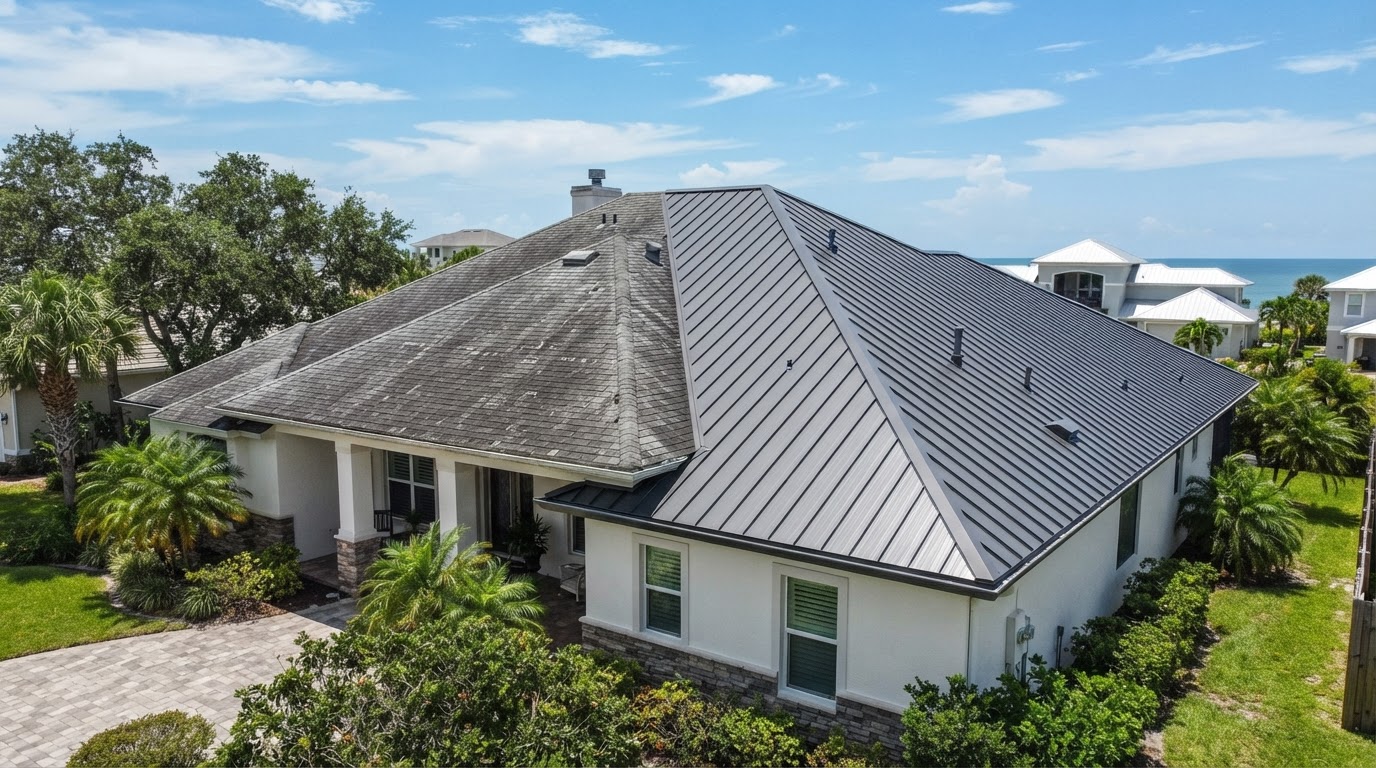
A shingle-to-metal conversion is the complete transition from an aging or storm-damaged asphalt shingle roof to a metal roofing system built for the western Florida Panhandle. For Pensacola homeowners tired of repeated shingle storm losses, metal offers continuous interlocking panels that resist wind uplift and shed wind-driven rain more effectively than individual shingle tabs. Whether your conversion requires a full tear-off or qualifies for a code-compliant roof-over, we specify the panel profile, gauge, substrate, and underlayment to match your roof geometry and proximity to the coast.
A shingle-to-metal roof conversion replaces an existing asphalt shingle system with a metal roofing system such as standing seam, 5V crimp, metal shingles, or stone-coated steel. The conversion typically involves a tear-off down to the deck, verification and re-nailing of sheathing, new underlayment, and installation of the metal panels and flashing. Whether a tear-off is required or an approved roof-over is possible depends on the number of existing shingle layers, deck integrity, and local code.
Why Pensacola Homeowners Switch From Shingles to Metal
The decision to convert from shingles to metal is usually driven by a combination of long-term ownership goals and Gulf Coast weather experience. Homeowners who plan to stay in their Pensacola property for many years, or who have already absorbed repeated shingle storm damage, often reach the point where another asphalt roof feels like a temporary fix rather than a lasting solution. Metal changes the conversation from repeated replacement to long-term performance.
- Long-term ownership goals—homeowners who want a roof intended to outlast several shingle life cycles
- Reduced maintenance exposure, especially with concealed-fastener standing seam that hides gaskets from sun and salt
- Gulf Coast weather resilience—continuous interlocking panels resist wind uplift better than individual shingle tabs
- Appearance—clean architectural lines and a range of profiles from modern standing seam to traditional metal shingles
- Heat and reflectivity considerations—metal can reduce attic heat gain with cool-roof color selections
- Material longevity potential when installed with proper underlayment, flashing, and deck preparation
- Resale considerations—some buyers view a metal roof as a premium, low-maintenance feature
- A reduced exposed asphalt roofing surface, which can mean less granule wash-off and fewer aging shingle tabs
We avoid universal claims. Metal is an excellent fit for many Pensacola homes, but it is not automatically superior for every budget, roof geometry, or ownership timeline. A homeowner selling in two years and a homeowner planning to retire in the home may reach different conclusions, and we present both honestly.
Choosing the Metal Roof System for Your Conversion
Metal roofing is a family of systems, not a single product. The right conversion panel depends on how residential you want the finished roof to look, your proximity to saltwater, your budget, and how much exposed-fastener maintenance you are willing to accept. This comparison frames the core options we install across Pensacola and Escambia County.
| Metal System | Fastener Type | Appearance | Maintenance | Typical Application | Coastal Considerations |
|---|---|---|---|---|---|
| Standing Seam | Concealed | Modern, continuous panels | Lowest exposed-fastener upkeep | Premium residential, waterfront | Excellent—fewest exposed points for salt |
| 5V Crimp | Exposed | Classic Florida profile | Periodic fastener inspection | Residential, rural-coastal | Good with proper gasket upkeep |
| Metal Shingles | Concealed/interlocking | Traditional shingle, shake, slate look | Low-moderate | Residential, traditional homes | Good—interlocking panels resist wind |
| Stone-Coated Steel | Concealed/fastener varies | Tile, shake, shingle texture | Low-moderate | Residential, architectural | Good—granule finish resists fade |
| R-Panel | Exposed | Ribbed, agricultural | Periodic fastener inspection | Barns, outbuildings, light-commercial | Useful for detached structures |
Explore each metal system
Tear-Off vs Approved Overlay for a Shingle-to-Metal Conversion
A shingle-to-metal conversion follows one of two paths, and the right one is determined entirely by what is found beneath the current shingles. A tear-off removes everything down to the deck so sheathing, fastening, and underlayment can be verified and brought to current code. An approved roof-over installs the metal over a single sound shingle layer when deck and code conditions permit. Both are legitimate engineering decisions—but only one is correct for a given roof.
During a tear-off conversion we inspect the deck for rot and re-nail sheathing to current high-wind requirements, install synthetic or peel-and-stick underlayment, renew flashing at every penetration and wall transition, and then install the metal system. During an approved overlay we verify the existing layer is flat and sound, add the required underlayment or drainage plane, and attach the metal per the manufacturer's roof-over method. The considerations below drive the choice.
- Existing shingle condition—flat and adhered supports overlay; curled and lifting requires tear-off
- Deck inspection—soft or rotten sheathing demands removal to repair the wood
- Existing roof layers—Florida code generally prohibits a third layer
- Underlayment—a tear-off allows a full code-compliant secondary water barrier
- Flashing—tear-off permits complete flashing renewal at valleys, walls, and penetrations
- Roof penetrations—older boots and vents are best replaced during a full removal
- Ventilation—a tear-off lets us rebalance ridge and soffit flow for the new assembly
- Cost and timeline—an overlay can reduce labor and disposal, but only when appropriate
Connected conversion resources
Converting Roofs Near the Pensacola Gulf Coast
A shingle-to-metal conversion near the coast is as much about material and coating selection as it is about panel profile. Salt-air exposure, wind, rain, and UV all shape which metal system will age gracefully on a Pensacola Beach or Perdido Key home versus an inland Cantonment property. The goal is a roof whose weakest link is not the first component to fail in the Gulf environment.
- Salt-air exposure—aluminum or high-grade Galvalume with PVDF finish preferred close to open water
- Wind—panel gauge, clip spacing, and edge fastening engineered for the local velocity zone
- Rain—sealed side laps and valley detailing that move large Gulf downpour volumes without backup
- UV—high-performance paint systems that resist chalking and coastal color fade
- Fasteners—marine-grade screws and gaskets matched to the panel and environment
- Panel coatings—factory finishes that hold color and resist salt-edge creep over decades
- Flashings—step, counter, and edge flashing detailed to channel wind-driven rain away from transitions
- Material selection—substrate chosen by exact distance from the water, not a blanket spec
- Roof geometry—valleys, dormers, and penetrations detailed to the panel system selected
We never imply that one material specification fits every coastal property. A home a few hundred feet from the Gulf on Pensacola Beach may warrant marine-grade aluminum, while a home a mile inland in Gulf Breeze may be well served by Galvalume steel. The recommendation is based on your exact location within Escambia and Santa Rosa counties.
The Shingle-to-Metal Conversion Process
A conversion is a sequenced project, not a single day of work. Planning the transition carefully is what protects the finished roof—every layer beneath the metal must be verified before the panels go down. This is the general sequence we follow for a Pensacola shingle-to-metal conversion, adjusted to your property and jurisdiction.
- 1Roof evaluation—inspect existing shingles, count layers, and assess deck condition
- 2Path determination—decide tear-off versus approved overlay based on the inspection
- 3Metal system selection—match panel profile, gauge, substrate, and coating to your wind zone and goals
- 4Written scope and estimate—itemize materials, underlayment, flashing, permits, and labor
- 5Tear-off or substrate preparation—remove shingles or prepare the overlay surface as determined
- 6Deck work—replace damaged sheathing and re-nail to current Florida Building Code where required
- 7Underlayment and flashing—install secondary water barriers and detail all transitions
- 8Metal installation and final review—panels, ridge, trim, ventilation, and a site walkthrough
Frequently Asked Questions
Ready to Convert Your Shingle Roof to Metal in Pensacola?
Contact Pensacola Metal & Shingle Roofing Contractors for a detailed written estimate across Pensacola, Escambia County, and Santa Rosa County.
Request Your Roofing Estimate
Direct consultation for Pensacola & Escambia County residential and coastal properties.