
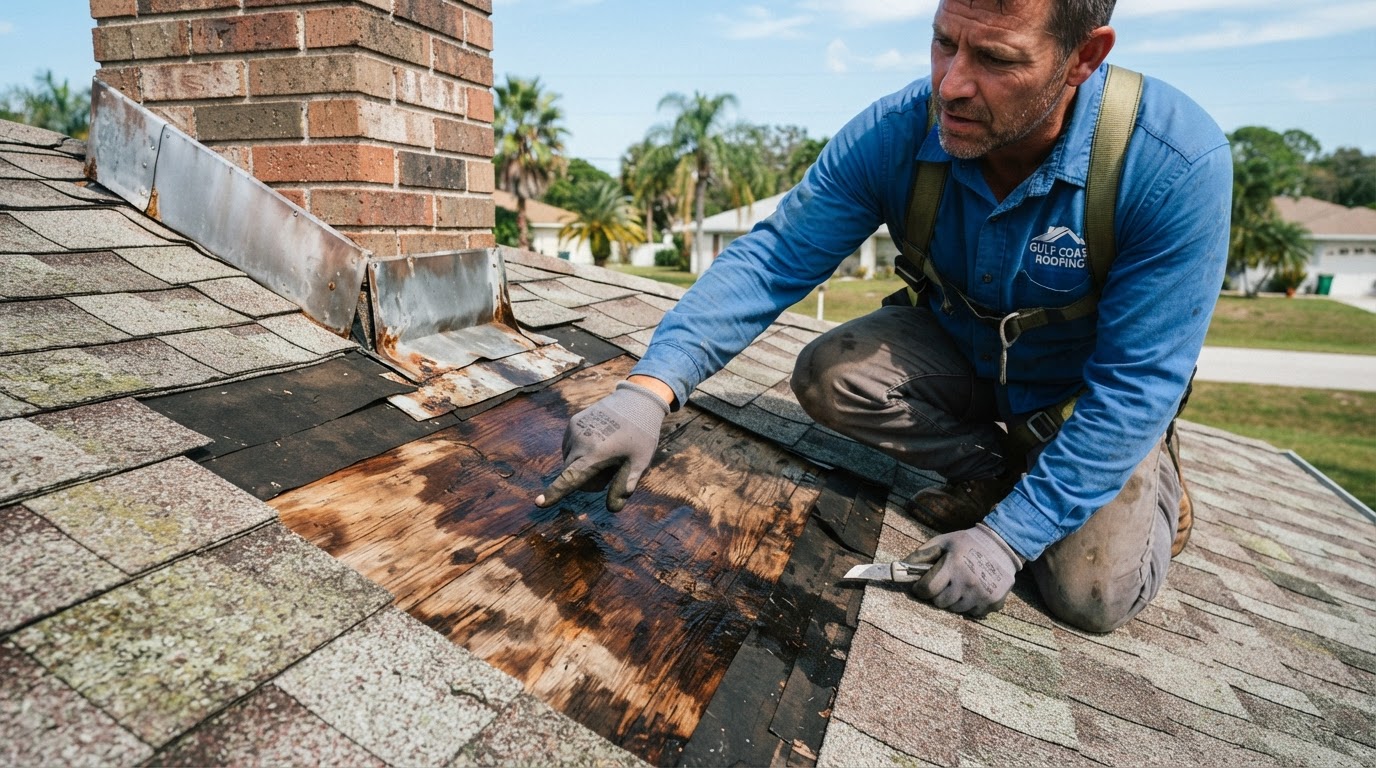
Roof Leak Repair Pensacola
A roof leak is the moment a roof problem stops being theoretical. Water inside the house means something in the roof assembly—shingles, metal panels, flashing, a valley, a fastener, a penetration—has failed, and the visible stain is often several feet from where the water actually entered. We diagnose and repair roof leaks on both metal and asphalt shingle roofing systems across Pensacola, Escambia County, and the western Florida Panhandle, tracing the water to its source before any repair is made.
A roof leak can originate from damaged shingles, metal panels, flashing, valleys, fasteners, roof penetrations, vents, skylights, or storm damage. The visible water stain inside the home may be several feet from the actual entry point, because water travels along roof decking, rafters, and interior surfaces before it drips. Proper diagnosis identifies the entry point before any repair is attempted, because sealing the stain's location without finding the source does not stop the leak.
Common Roof Leak Sources
Roofs leak in predictable places. The components where the roof is interrupted or joined—penetrations, valleys, transitions, and edges—are where water most often finds a way in. A diagnostic approach reviews each of these sources rather than assuming the leak is directly above the visible stain.
Missing or Lifted Shingles
Storm-lifted or missing shingles expose the underlayment and deck to wind-driven rain, often leaking only during heavy storms.
Shingle Roof Leak RepairMetal Panel Seams & Fasteners
Open seams, backed-out screws, and failed washers let water enter at points that look intact from below. Metal leaks often trace to fasteners and penetrations.
Metal Roof RepairMetal Roof Screw & Fastener ReplacementValleys & Flashing
Valleys collect and direct the most water on the roof; flashing failures at walls, chimneys, and transitions let wind-driven rain behind the weather barrier.
Roof Valley RepairRoof Flashing & Chimney RepairPenetrations
Pipe boots, roof vents, and skylights are common leak points because their seals and flashing deteriorate from UV and heat over time.
Pipe Boot & Roof Vent RepairSkylight Flashing & Leak RepairRidge & Edge Areas
Ridge caps, hip shingles, and drip edge are exposed to the highest wind pressures and can lift or fail during storms.
Ridge Cap & Hip Shingle RepairStorm Damage
Wind, debris impact, and wind-driven rain can create leaks that appear only under storm conditions and may not be obvious afterward.
Metal Roof Leaks vs Shingle Roof Leaks
Metal and shingle roofs leak differently because they are assembled differently. Understanding the difference matters because the repair that fixes a shingle leak can be useless on a metal roof, and vice versa. The diagnostic approach shifts with the roofing system.
| Factor | Metal Roofs | Shingle Roofs |
|---|---|---|
| Most common leak source | Exposed fasteners, seams, penetrations, flashing | Missing or damaged shingles, valleys, flashing, penetrations |
| Fastener failure | Backed-out screws, failed washers, loose panels | Nail pops, lifted tabs, creased shingles |
| Corrosion factor | Rust around fasteners and cut edges, coating breakdown | Not applicable—granule loss and mat exposure instead |
| Diagnosis focus | Seams, clips, fastener lines, penetration flashing | Shingle condition, valley integrity, underlayment, flashing |
Material-specific leak repair
How Roof Leak Diagnosis Works
Finding a leak is a process of elimination, not a guess. Water leaves evidence—stains, moisture, damage—that trace a path from the entry point to the visible drip. A systematic diagnosis follows that evidence backward to the source rather than sealing the first suspicious spot and hoping the leak stops.
- 1Review interior symptoms—the stain location, when it appears, and whether it correlates with rain or wind direction.
- 2Inspect the attic where accessible, looking for moisture, water trails, and deck damage that reveal the water's path.
- 3Examine the roof surface above and up-slope of the interior evidence, since water travels before dripping.
- 4Check each common leak source—flashing, valleys, penetrations, fasteners, and damaged materials.
- 5Confirm the likely entry point and assess whether the leak is isolated or part of a broader roof problem.
We do not guarantee source identification without inspection. Some leaks require moisture testing or removal of materials to confirm the exact entry point. Diagnosis identifies the probable cause based on the evidence available, and a repair addresses that cause rather than the visible symptom alone.
What to Do When a Roof Starts Leaking
When water appears inside the house, the priority is protecting the interior and documenting the situation safely—not climbing onto a wet, possibly storm-damaged roof. The steps below protect belongings and preserve evidence without putting anyone at risk.
- Protect interior belongings—move furniture and valuables away from the water path and cover what cannot be moved
- Contain interior water where safely possible—place buckets or towels to catch drips and limit damage
- Photograph visible damage—document the stain, the water, and any visible roof damage for insurance or repair records
- Avoid climbing onto wet or storm-damaged roofing—a wet roof is a fall hazard, and storm damage can hide weak decking
- Arrange professional inspection—have the leak diagnosed and repaired before the next rain compounds the damage
- Use emergency protection when appropriate—tarping or temporary cover for severe active leaks during storms
We do not provide DIY climbing instructions. A wet or storm-damaged roof is dangerous to walk on, and some deck damage is not visible from the surface. Professional diagnosis and, where needed, emergency tarping are safer than self-inspection during or immediately after a storm.
If the leak follows a storm
Roof Leaks After Heavy Rain & Storms Near Pensacola
Pensacola's weather produces leaks that follow recognizable patterns. Wind-driven rain enters through openings that hold up in calm rain. Tropical systems test every penetration and seam at once. And repeated heavy rainfall finds the weakest detail on the roof and exploits it. Understanding why a leak appears only in certain conditions helps explain why intermittent leaks still deserve attention.
- Wind-driven rain that forces water beneath flashing and lifted materials that would hold in calm rain
- Tropical storms that stress every flashing, penetration, and seam simultaneously
- Flashing vulnerabilities exposed only when wind pushes rain against a specific roof face
- Lifted roofing materials—shingle tabs or metal panels—displaced just enough to break the seal
- Fastener damage—screws loosened or washers compressed by storm cycling
- Debris impact that cracks shingles, dents panels, or displaces flashing
- Repeated heavy rainfall that finds the weakest detail and exploits it over multiple storms
An intermittent leak—one that appears only during heavy rain or wind from a certain direction—is still a real leak. It means a component has failed enough to let water in under specific conditions, and those conditions will recur on the Gulf Coast. The fact that it does not leak every time it rains does not mean it will resolve itself; it usually means the next severe storm will make it worse.
Related leak and repair services
Leak Repair vs Roof Replacement
Not every leak means the roof needs replacing. Most leaks are localized failures—failed flashing, a cracked pipe boot, a damaged valley—that can be repaired without reroofing. But a leak can also be a symptom of a roof that has reached end-of-life, and repairing one leak on a failing roof only defers the next one. Knowing the difference requires understanding the roof's overall condition, not just the leak in front of you.
- Localized repair fits when the roof is otherwise serviceable and the leak is an isolated component failure
- Partial reroof fits when damage is concentrated in one roof section but the rest is sound
- Full replacement fits when leaks are recurring, the roof is aged, or multiple areas are failing
- The decision depends on roof age, the number and pattern of leaks, and overall material condition
Connected repair and replacement options
Frequently Asked Questions
Water Inside? Let's Find the Source in Pensacola.
Contact Pensacola Metal & Shingle Roofing Contractors for a detailed written estimate across Pensacola, Escambia County, and Santa Rosa County.
Request Your Roofing Estimate
Direct consultation for Pensacola & Escambia County residential and coastal properties.