Metal Roof Hurricane Damage Repair Pensacola
Metal roofing may remain largely intact after a storm while still sustaining localized damage to panels, seams, fasteners, flashing, ridge components, or roof edges. A post-storm inspection should evaluate the complete assembly before deciding between repair and replacement. We repair storm-damaged metal roofs across Pensacola, Escambia County, Santa Rosa County, and the western Florida Panhandle—tracing each defect to its source and correcting the actual failure, not just coating over it.
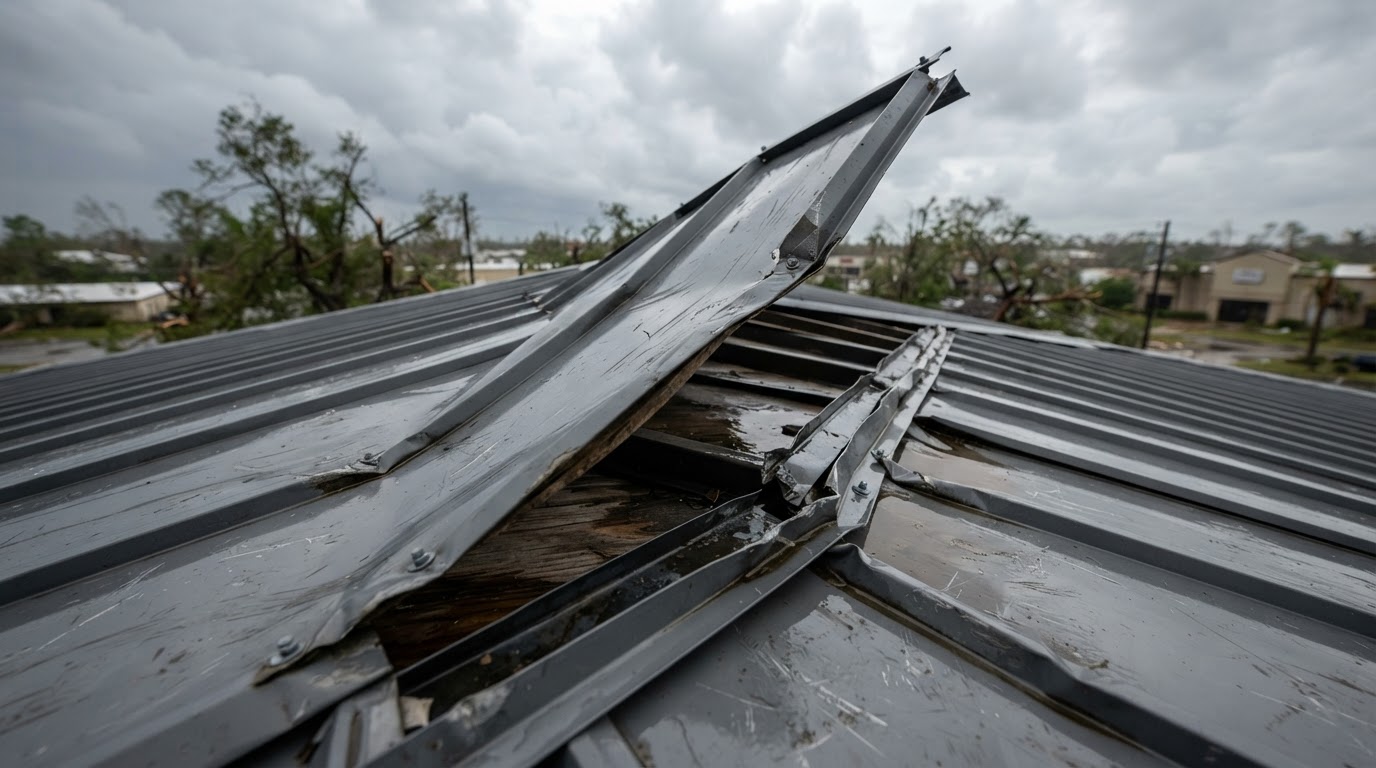
Hurricane damage on a metal roof often shows up as bent or loose panels, backed-out fasteners, open seams, damaged ridge or edge flashing, debris impact, and penetration leaks—even when most of the roof still looks sound from the ground. Standing seam and exposed-fastener systems fail differently: concealed clips and seams versus exposed screws and washers. A post-storm inspection should check panels, seams, fasteners, ridge, edges, flashing, penetrations, and the deck before any repair scope is set. Homeowners should not climb onto a wet or storm-damaged metal roof.
Common Hurricane Damage on Metal Roofs
Hurricane damage on a metal roof is rarely uniform. Wind, debris, and wind-driven rain hit different parts of the assembly in different ways, and the failure points differ between standing seam and exposed-fastener systems. Knowing where metal roofs tend to fail after a storm is the first step in scoping a repair that actually fixes the damage rather than just covering it.
- Bent panels from wind uplift or debris impact
- Loose or displaced panels where attachment has failed
- Backed-out fasteners on exposed-fastener systems
- Damaged or deteriorated washers that have lost their seal
- Open seams where panels have separated at the join
- Ridge damage—loosened or lost ridge caps and closures
- Edge and eave flashing damage where uplift concentrates
- Debris impact—branches, limbs, or wind-borne objects
- Penetration leaks around vents, pipes, and skylights
- Surface or coating damage exposing the substrate to corrosion
Standing seam systems tend to fail at the clips, seams, and ridge before the panel face gives way, because the fasteners are concealed and the panel is designed to move. Exposed-fastener systems like 5V crimp and R-panel tend to fail at the screws and washers—the points of penetration—and at the laps where panels overlap. Both can be repaired when the damage is localized, and both can require replacement when the system damage is widespread.
What Should Be Inspected After the Storm?
A thorough post-hurricane metal roof inspection looks at the whole assembly, not just the panels a homeowner can see from the ground. The checklist below is the scope a professional inspection should cover after a significant wind event, because storm damage on metal roofing is often at the connections rather than the visible surface.
- Panels—bends, dents, displacement, and impact marks
- Seams—standing-seam separation or 5V/R-panel lap movement
- Fasteners—backed-out screws, loose washers, missing fasteners
- Ridge—ridge caps, closures, and ridge flashing
- Eaves and rakes—edge metal and drip edge condition
- Flashing—wall, headwall, sidewall, and penetration flashing
- Valleys—metal valley condition and underlayment exposure
- Penetrations—pipe boots, vents, and skylight flashing
- Decking evidence—water stains or soft spots where accessible
- Interior leaks—new ceiling stains or attic moisture
- Soffit and fascia—roof-edge damage from uplift
- Adjacent roof components and transitions
Do not climb onto a wet or storm-damaged metal roof to inspect it. Metal is slippery when wet, storm damage can hide weakened decking, and wind-loosened panels may not hold weight. Photograph visible damage from the ground or a safe vantage point and arrange a professional inspection instead. Personal safety comes before any roof assessment.
Repair vs Panel Replacement vs Full Reroof
Storm damage on a metal roof does not automatically mean a full reroof. Most hurricane damage is localized—a few bent panels, a field of loosened fasteners, one failed flashing transition—and can be repaired or addressed with panel replacement while the broader system stays in service. The right scope follows the inspection, and it falls into three general paths.
| Path | When It Fits |
|---|---|
| Repair | A localized fastener, flashing, or seam problem on an otherwise serviceable system |
| Panel replacement | Specific panels significantly damaged while the broader system remains sound |
| Full reroof | Widespread system failure, major corrosion, or extensive storm damage across the roof |
The decision between repairing a damaged panel and replacing it depends on whether the panel is structurally sound after the dent or bend, whether the coating is intact, and whether the surrounding attachment is still reliable. A small dent in an otherwise sound panel may remain in service; a panel that has lost its seal, moved at the seam, or torn at a fastener usually needs replacement. The inspection determines which path fits before any work begins.
Related metal roof repair services
Storm-Damaged Metal Roofs Near Pensacola
Pensacola metal roofs face a specific combination of storm stresses: strong uplift from Gulf hurricanes, wind-driven rain that finds every open seam or flashing gap, debris impact from trees and wind-borne objects, and—nearer the coast—salt deposition that can accelerate corrosion after a storm exposes fresh metal. Flashing can move under wind load, and water intrusion can appear at connections that looked intact before the event.
After a coastal storm, it is worth monitoring for post-storm corrosion where the storm may have scratched coatings or exposed cut edges, especially on properties closer to Pensacola Beach, Perdido Key, Gulf Breeze, and Navarre. A prompt inspection catches fastener and flashing damage while it is still a repair rather than waiting until the next rain turns it into an interior leak.
Storm recovery for metal roofing
Document the Damage Before Repairs Begin
Before any storm-damaged metal roof is repaired, the damage should be photographed and documented from safe locations. Fresh documentation supports any insurance process and gives the roofer a clear record of what the storm did versus what may have been pre-existing. This is especially important on metal roofs, where storm damage and aging can look similar once panels are cleaned up.
- Photograph visible panel, seam, and fastener damage from safe vantage points
- Note the date and weather event that caused the damage
- Record any interior stains or leaks that appeared after the storm
- Keep the inspection report and repair scope together
- Save any emergency-mitigation receipts if tarping was used
Documentation does not determine insurance coverage. Whether a claim is approved depends on the policy, cause of loss, the insurer's investigation, and applicable requirements. The value of documentation is that it creates an organized record of what was observed—not that it guarantees a claim outcome.
Related storm documentation resources
Frequently Asked Questions
Metal Roof Storm Damage? Let's Inspect It in Pensacola.
Contact Pensacola Metal & Shingle Roofing Contractors for a detailed written estimate across Pensacola, Escambia County, and Santa Rosa County.
Request Your Roofing Estimate
Direct consultation for Pensacola & Escambia County residential and coastal properties.