Storm Damage Roof Inspection Pensacola
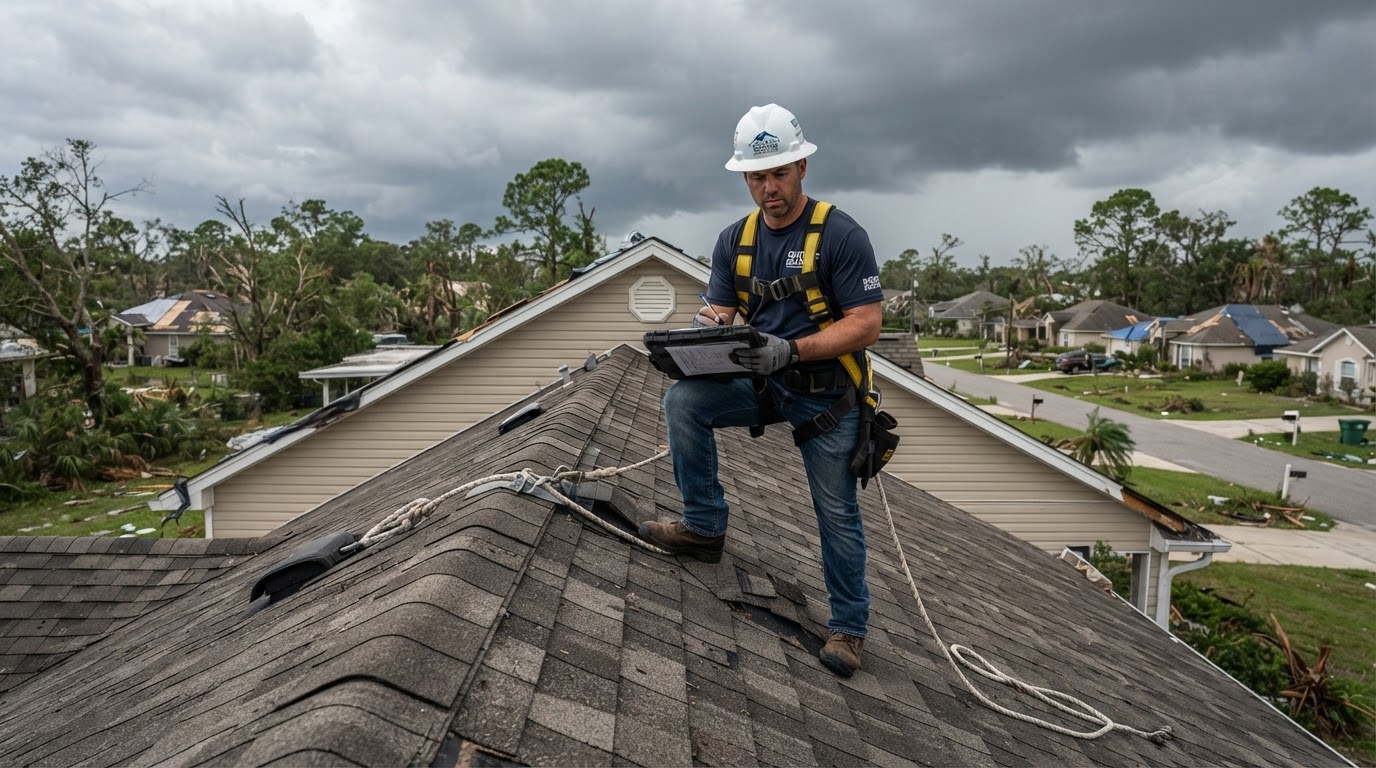
A storm damage roof inspection should look beyond obvious missing shingles. Wind, rain, and debris can affect roof coverings, edges, flashing, vents, fasteners, underlayment, and decking without creating immediate interior symptoms—and that hidden damage leaks later, not during the storm. We perform post-storm roof inspections across Pensacola, Escambia County, Santa Rosa County, and the western Florida Panhandle, documenting what the storm actually did before any repair or replacement is recommended.
A storm damage roof inspection evaluates the roof covering, edges, flashing, penetrations, fasteners, underlayment, and decking for storm-related damage, plus any interior or attic signs of water intrusion. It looks for damage that is visible from the ground and damage that is not—creased shingles, loosened fasteners, moved flashing, exposed underlayment. The goal is to scope what the storm actually did so repair or replacement recommendations follow the damage, not an assumption. Homeowners should not climb onto a wet or storm-damaged roof themselves.
What the Exterior Inspection Looks For
The exterior inspection is where most storm damage is found, but it is not just a scan for missing shingles. Wind, rain, and debris affect different roofing systems in different ways, and a thorough inspection checks each system's known failure points—from shingle tabs and ridge caps to metal seams and exposed fasteners—plus the components every roof shares.
Shingle Roofs
Missing shingles, lifted or creased tabs folded back at the fastener line, ridge-cap damage, granule disruption from impact, and direct impact damage from debris.
Shingle Roof RepairMissing & Lifted Shingles After High WindsMetal Roofs
Panel displacement, fastener condition, seam engagement, edge details, flashing at penetrations, and dents or impact areas where debris has struck the panels.
Metal Roof RepairAll Roofs
Valleys, vents, flashing, skylights, chimneys, soffit and fascia at the roof edge, and debris damage anywhere the storm has impacted the assembly.
Roof Valley RepairSoffit, Fascia & Drip Edge RepairThe absence of missing shingles does not mean the roof is undamaged. High winds can crease shingles that still sit flat, loosen fasteners that still look attached, and open flashing gaps that only leak under the next wind-driven rain. A storm inspection checks the details that fail subtly, not just the damage that is obvious from the curb.
Interior & Attic Warning Signs
Where it is safe to access the attic, the interior side of the roof can reveal what the exterior hides. Water staining, wet insulation, deck discoloration, daylight through openings, and moisture around penetrations are all signs that storm water has found a path in. These signs matter even when no stain has appeared on the living-space ceiling yet.
- Water staining on roof deck or rafters
- Wet or compressed insulation in the attic
- Deck discoloration or darkened wood
- Daylight visible through roof openings
- Moisture around pipe boots, vents, or penetrations
- Active dripping during or after the storm
- New ceiling stains in the living space below
- Musty odor suggesting trapped moisture
Do not enter an unsafe attic to look for leaks. Storm damage can weaken decking that is not visible from below, and a sagging or soft ceiling may indicate water weight above it. If an attic or ceiling looks structurally compromised, stay out and arrange a professional inspection. The absence of visible interior leakage also does not prove the roof escaped damage—water can travel and appear later.
What Happens After Damage Is Identified?
Once the inspection is complete, the findings map to a decision pathway. Not every storm-damaged roof needs replacement, and not every damaged roof can be safely left until scheduling is convenient. The pathway below is what the inspection results should lead to, in order of severity.
| Finding | Typical Path |
|---|---|
| No significant visible storm damage | Monitor and maintain; re-inspect after the next event if needed |
| Minor or localized repair | Correct the specific damaged components |
| Exposed or actively leaking area | Emergency protection / tarping first, then repair |
| Damage concentrated to one section | Partial reroof of the affected roof plane |
| Broad or system-wide damage | Complete reroof |
| Structural or complex concern | Additional specialist evaluation when needed |
Related storm recovery paths
Documenting Storm Damage
Documentation is part of the inspection. Photographs, the location of the damage, the date and weather event, interior symptoms, the contractor's inspection notes, the repair recommendations, and any receipts or invoices together form the record that supports decisions and any insurance process. Fresh documentation is more useful than reconstruction after the fact.
- Photographs of visible damage from safe locations
- Location of each damaged area noted on the roof
- The date and weather event that caused the damage
- Interior symptoms—stains, leaks, attic moisture
- Contractor inspection notes and repair recommendations
- Receipts and invoices for any emergency mitigation
Documentation does not guarantee that an insurance claim will be approved. Coverage depends on the policy, the cause of loss, the insurer's investigation, and applicable requirements. What documentation does is create an organized, dated record of what was observed—which is valuable regardless of whether a claim is filed.
Deeper documentation guidance
A Roofing Inspection Is Not an Insurance Adjustment
A storm damage roof inspection evaluates the roof's condition and identifies what roofing work it needs. It is not the same as an insurance adjustment, a wind mitigation inspection, or a four-point inspection—each of which has a different purpose and a different party responsible for it. Knowing the difference helps homeowners request the right service for what they actually need.
- Roofing inspection—scopes roof condition and needed roofing work
- Insurance adjustment—handled by the insurer's adjuster as part of a claim
- Wind mitigation inspection—documents qualifying wind-resistant features
- Four-point inspection—reviews roof, electrical, plumbing, and HVAC
Related inspection types
Frequently Asked Questions
After a Storm? Let's Inspect the Roof in Pensacola.
Contact Pensacola Metal & Shingle Roofing Contractors for a detailed written estimate across Pensacola, Escambia County, and Santa Rosa County.
Request Your Roofing Estimate
Direct consultation for Pensacola & Escambia County residential and coastal properties.