
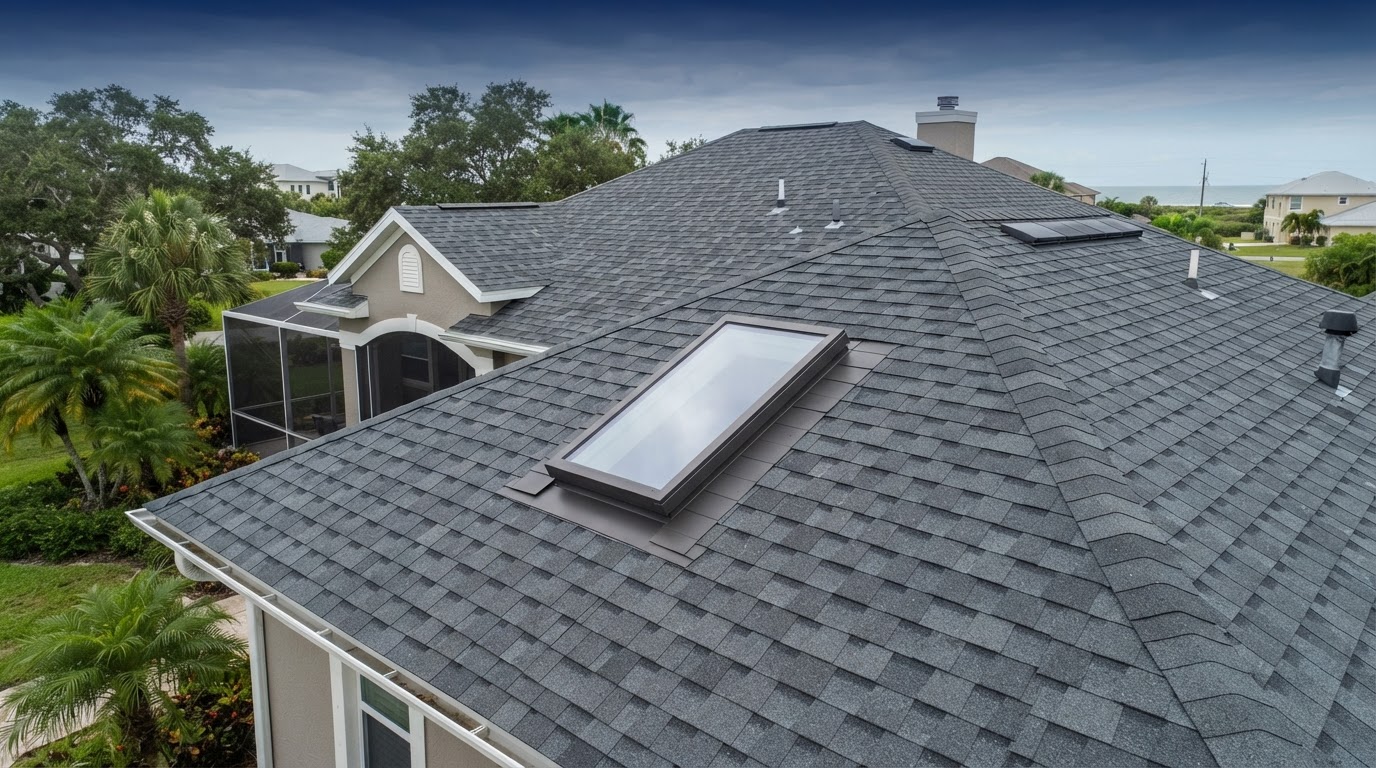
Skylight Flashing & Leak Repair Pensacola
A water stain appearing below a skylight is one of the most misdiagnosed roof problems in Pensacola homes. The instinct is to blame the skylight itself, but in most cases the water is entering through the flashing, the surrounding shingles, or a nearby roof defect and traveling along the roof plane before it becomes visible indoors. We diagnose skylight leaks across Pensacola and Escambia County by tracing the actual water path rather than assuming the skylight has failed—and we repair the flashing and roofing system that is letting water in.
A leak appearing around a skylight does not automatically mean the skylight itself has failed. Water can enter through failed or improper flashing, damaged surrounding shingles, deteriorated seals, nearby roof penetrations, or roof-system defects and travel before becoming visible indoors. Proper diagnosis traces the actual water entry point rather than assuming the skylight is the source. In most cases a flashing or roofing repair resolves the leak without replacing the skylight.
Why a Skylight Starts Leaking
A skylight is a hole in the roof, and every hole in the roof depends on its flashing to stay watertight. When water appears below a skylight, the most productive question is not whether the skylight is broken but where the water is actually entering. Skylight leaks fall into a handful of recognizable categories, and identifying the category determines whether the repair is a small flashing fix or a larger roofing project.
Failed or Improper Flashing
Step flashing, apron flashing, and head flashing integrate the skylight curb with the surrounding shingles. When flashing is installed incorrectly, corroded, or lifted by wind, water enters at the seam between the skylight and the roof.
Aging Seals & Gaskets
The gaskets and sealants between the skylight frame, the glass, and the curb deteriorate from UV and heat over time. A dried-out gasket can allow wind-driven rain to penetrate without any visible shingle damage.
Damaged Roofing Around the Skylight
Lifted or cracked shingles, loose metal panel fasteners, and failed underlayment immediately around the skylight create direct water paths. The skylight may be fine while the roof around it has failed.
Condensation vs Roof Leak
Interior moisture around a skylight is not always a roof leak. Condensation from humidity and temperature differences can collect on skylight glass and frame and mimic a leak. A proper diagnosis distinguishes the two.
We do not diagnose a skylight leak without inspection. Because water travels, the visible interior stain is often far from the actual entry point. A surface assumption—'the skylight is leaking'—frequently leads to replacing a skylight that was never the problem.
How Skylight Leaks Are Traced
Tracing a skylight leak is a diagnostic process, not a guess. The goal is to identify the exact entry point so the repair addresses the cause rather than the symptom. Simply adding caulk around a skylight frame often conceals the real failure without correcting it, which is why so many skylight 'repairs' recur season after season.
- 1Review visible interior symptoms—stain location, spread pattern, and when it appears
- 2Examine the roof area around the skylight from above
- 3Inspect surrounding shingles or metal panels for lifting, cracking, or damage
- 4Evaluate flashing interfaces—step, apron, and head flashing condition and integration
- 5Inspect seal and gasket condition at the skylight frame and curb
- 6Look for nearby water-entry points above or alongside the skylight
- 7Evaluate underlayment and deck damage where accessible from the attic
- 8Determine repair scope based on the actual entry point found
Adding surface caulk over a failed flashing detail is one of the most common—and most temporary—skylight 'repairs.' Caulk does not restore a lifted flashing or replace deteriorated step flashing; it only masks the visible symptom while water continues to enter beneath it. A correct repair addresses the failed component, not its appearance.
Connected leak and flashing services
Skylights & Pensacola Storm Conditions
A skylight is a roof opening, and along the Gulf Coast every roof opening is a flashing detail that has to survive wind-driven rain, tropical weather, and thermal cycling. Pensacola's storm exposure tests skylight flashing harder than almost any other roof detail, because the combination of wind pressure and horizontal rain finds any gap in the flashing assembly.
- Wind-driven rain—horizontal rain that forces water beneath loose or aging flashing
- Tropical weather—sustained storms that test every flashing seam for hours
- Heavy rain—large water volume that overwhelms gaps that hold in light rain
- UV exposure—sun that dries out gaskets, sealants, and flashing seals over time
- Seal deterioration—the gradual breakdown of the flexible seals around the skylight
- Debris impact—branches and storm debris that can damage roofing around the skylight
- Roof movement—thermal expansion and contraction that shift flashing from its sealed position
This is why a skylight that has been watertight for years can suddenly leak after a single storm. The flashing did not necessarily fail during the storm—it had been aging and loosening for years, and the storm was the first event with enough wind-driven rain to push water through the gap that had been forming. Across Pensacola, Escambia County, and the western Florida Panhandle, skylight flashing deserves periodic inspection for exactly this reason.
Repair, Reflash, or Larger Roof Work?
Not every skylight leak requires the same scope. The correct repair depends on what the diagnosis finds, the condition of the roof around the skylight, and whether the leak is isolated or part of broader roof deterioration. We present the options honestly rather than defaulting to the most expensive fix.
Localized flashing repair may be the right answer when the roof around the skylight remains serviceable, the damage is isolated to the flashing or a small area of shingles, the decking is intact, and the skylight assembly itself remains suitable. In those cases, re-flashing and replacing damaged shingles resolves the leak without touching the rest of the roof.
- Roof around skylight remains serviceable with useful life remaining
- Damage is isolated to flashing or a small area of adjacent shingles
- Decking beneath and around the skylight is intact and dry
- Skylight assembly itself remains suitable and watertight at the frame
Broader work may be needed when the roofing around the skylight is deteriorated, deck damage is discovered beneath the leak, leakage has recurred after previous repairs, multiple surrounding roof defects exist, or a full roof replacement is already warranted. In those cases, patching the skylight flashing while the surrounding roof is failing simply delays the larger problem.
When broader work is warranted
The Roof-to-Skylight Transition
The detail that determines whether a skylight leaks is the transition between the skylight curb and the roof. Step flashing weaves into the shingle courses up the sides of the skylight, an apron flashing carries water away from the front, and a head flashing sheds water over the top. Each piece has to lap correctly, integrate with the underlayment, and shed water downhill without trapping it.
- Step flashing—woven into shingle courses up the sides of the skylight curb
- Apron flashing—carries water away from the front of the skylight
- Head flashing—sheds water over the top of the skylight
- Underlayment—integrated beneath the flashing as a secondary water barrier
- Curb integration—the skylight curb sealed to the roof opening
- Shingle lapping—shingles layered to direct water around, not into, the opening
When a skylight is installed during a reroof, the flashing and underlayment are integrated with the new roof system from the start—the ideal scenario. When a skylight is added to an existing roof, or the flashing ages, the transition becomes a maintenance point that needs periodic inspection to stay watertight through Pensacola's storm seasons.
Frequently Asked Questions
Water Appearing Around a Skylight in Pensacola?
Contact Pensacola Metal & Shingle Roofing Contractors for a detailed written estimate across Pensacola, Escambia County, and Santa Rosa County.
Request Your Roofing Estimate
Direct consultation for Pensacola & Escambia County residential and coastal properties.