Roof Flashing & Chimney Leak Repair Pensacola
Flashing is where most roof leaks actually start. It is the metal that waterproofs the joints, transitions, and penetrations where shingles or metal panels alone cannot create a reliable seal—chimneys, walls, valleys, skylights, and pipe penetrations. When flashing loosens, corrodes, or was installed incorrectly, wind-driven rain finds the gap and enters the roof. We repair and replace roof flashing at chimneys, walls, and transitions across Pensacola, Escambia County, and the western Florida Panhandle, focusing on the roofing details that cause the leaks.
Roof flashing directs water away from joints and transitions where roofing materials alone cannot create a reliable weather barrier. Chimneys, walls, roof intersections, and penetrations are common flashing locations and can become significant leak points when details loosen, corrode, or deteriorate. Because flashing failures leak primarily during wind-driven rain, they are often mistaken for roof-covering failures, when the actual entry point is the flashing detail.
Where Roof Flashing Is Used
Flashing is installed wherever the roof is interrupted—where it meets a vertical surface, where two roof planes meet, or where something passes through it. Each location has a flashing detail designed to shed water away from the joint. Knowing where flashing lives on a roof is the first step in understanding where leaks originate.
- Chimneys—the most common flashing leak source, where roof meets masonry
- Roof-to-wall intersections—where a roof slope meets a vertical wall
- Sidewalls—where roofing runs alongside a wall along a slope
- Headwalls—where a roof slope runs up to a vertical wall at the top
- Valleys where applicable—where two roof planes meet and concentrate water
- Skylights—flashing around the frame where the unit meets the roof
- Plumbing penetrations—pipe boots and vent flashing
- Roof transitions—where one roof section meets another at different heights or angles
- Drip-edge relationships where appropriate—at eaves and rakes to direct water off the roof edge
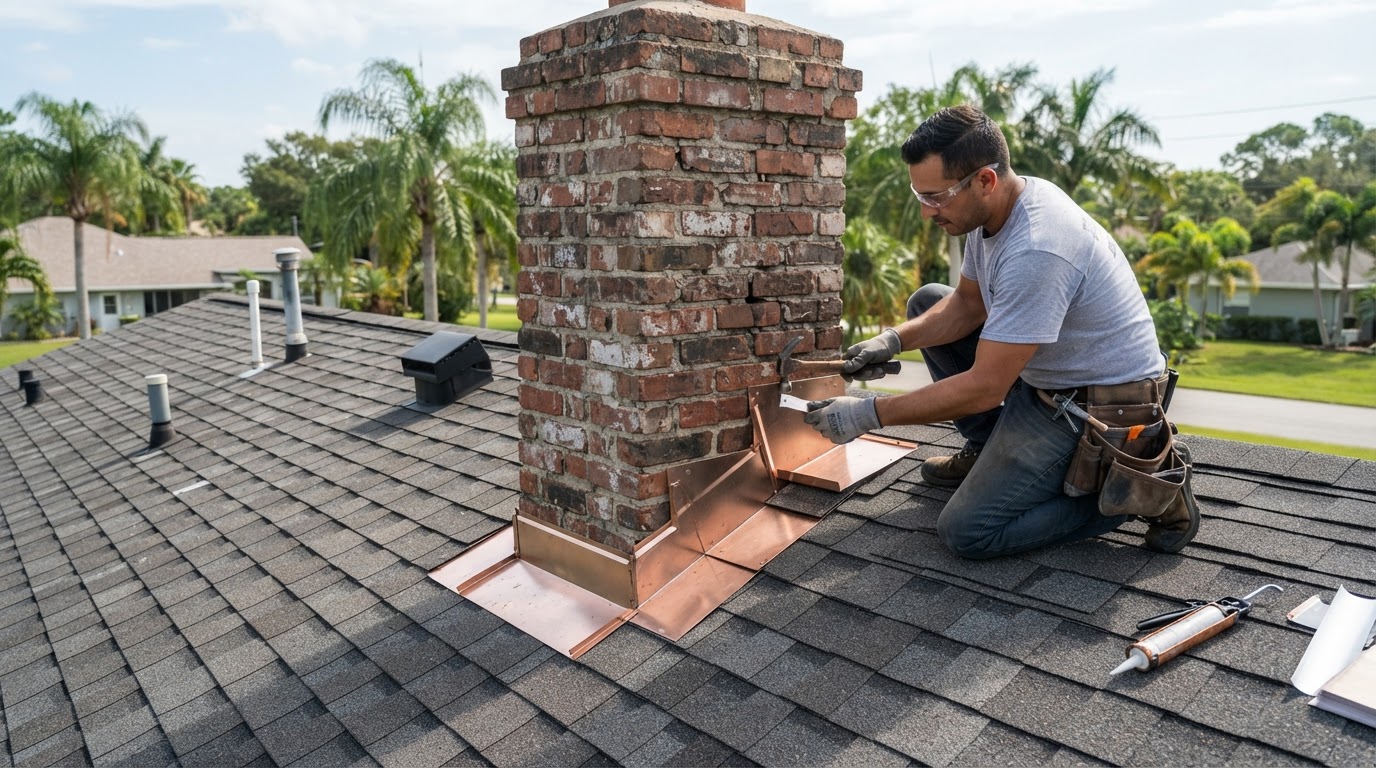
The main flashing types—step flashing, counterflashing, and apron flashing—work together at transitions. Step flashing layers with the shingles up a wall; counterflashing covers the top of the step flashing where it meets a vertical surface; apron flashing covers the downhill side of a penetration like a chimney. Understanding which is which helps explain where a specific leak originates.
Common Flashing Failure Signs
Flashing failures leave evidence both inside and out. Interior stains near a chimney or wall, leaks that appear during wind-driven rain, and visible deterioration of the metal are the most common signs. Because flashing leaks are wind-dependent, the pattern of when the leak appears is itself a diagnostic clue.
- Interior stains near a chimney, wall, or roof transition—the most common indoor sign
- Water intrusion during wind-driven rain—leaks that appear only when wind pushes rain against a specific face
- Loose metal flashing that has lifted or pulled away from the roof or wall
- Rust or corrosion on metal flashing components exposed to weather
- Failed sealants—caulk or mastic that has cracked, shrunk, or pulled away from the joint
- Missing flashing—details that were never properly installed or have been displaced
- Improper previous patching—sealant applied over a failed detail rather than correcting it
- Damaged shingles around transitions—roofing materials compromised where flashing has failed
- Moisture-damaged decking—evidence of long-term water intrusion at a flashing location
Related flashing and leak services
Chimney Roof Leaks
A chimney is the most complex flashing detail on most roofs, and water near a chimney can come from several sources—not all of them the flashing. Correct diagnosis matters before assuming the flashing is the problem, because repairing the wrong component does not stop the leak.
- Roof flashing—the step and apron flashing where the roof meets the chimney base
- Counterflashing—the metal set into the masonry that covers the top of the step flashing
- Roof covering—damaged shingles around the chimney that let water behind the flashing
- Water entering higher on the roof and traveling down to the chimney area
- Chimney cap or masonry issues outside the roofing scope—sources a roofing repair cannot address
We keep this page roofing-focused. A leak near a chimney can originate from chimney masonry, the chimney cap, or the flashing—and only the flashing is a roofing repair. If the leak source is masonry or the cap rather than the roof flashing, we identify it and recommend the appropriate masonry professional rather than performing work outside the roofing scope.
Flashing Under Pensacola Rain & Wind Conditions
Pensacola's weather tests flashing in specific ways. Wind-driven rain is the most important—flashing that holds up in calm rain fails when wind pushes water up and behind the detail. Tropical storms stress every flashing transition at once. Heavy rainfall finds the weakest joint. And thermal movement from Florida heat works flashing loose over seasons, even on a roof that otherwise looks intact.
- Wind-driven rain that pushes water up and behind flashing that holds in calm rain
- Tropical storms that stress every flashing transition simultaneously
- Heavy rainfall that finds the weakest joint and exploits it
- Salt exposure near the coast that accelerates corrosion of metal flashing components
- Thermal movement from Florida heat that works flashing loose over seasons
- Repeated wetting and drying that degrades sealants and accelerates corrosion
- Metal compatibility—mixed metals at transitions that can create corrosive interaction
Surface caulk alone is often not a durable substitute for proper flashing correction. Caulk bridges a gap temporarily, but it does not re-establish the flashing detail that shed water in the first place. A flashing repair that relies on caulk will fail as the caulk ages, which is faster in Florida sun and heat. Proper correction repairs or replaces the flashing detail itself.
Flashing Repair vs Roof Replacement
A flashing leak does not automatically mean the roof needs replacing. Flashing is a component that can be repaired or replaced independently when the surrounding roofing is serviceable. But flashing failure can also be a symptom of a roof that has broader problems, and repairing the flashing on a failing roof only defers the next leak. Knowing the difference requires understanding the roof's overall condition, not just the flashing in front of you.
- Flashing repair fits when the surrounding roofing is serviceable and the failure is isolated to the flashing detail
- Flashing replacement fits when the existing flashing has failed broadly or was never properly installed
- Partial reroof fits when flashing failure is part of a larger problem in one roof section
- Full replacement fits when flashing failures are recurring alongside broader roof deterioration
- The decision depends on the condition of the roofing around the flashing, not the flashing alone
Connected repair and replacement options
Flashing Leaks on Metal & Shingle Roofs
Both metal and shingle roofs develop flashing leaks, though the details differ. Shingle roofs rely on step, counter, and apron flashing layered with the shingles. Metal roofs have their own flashing details at panel transitions, penetrations, and walls—and metal flashing can corrode where shingle flashing typically does not. The repair approach matches the roofing system, because the flashing details are not interchangeable.
- Shingle roof flashing—step, counter, and apron flashing layered with shingles at transitions
- Metal roof flashing—transition and penetration flashing specific to the panel system
- Corrosion risk—metal flashing on metal roofs can corrode, particularly near the coast
- Sealant reliance—both systems can suffer when flashing is patched with caulk rather than repaired
- System-specific repair—flashing details are not interchangeable between metal and shingle roofs
Material-specific flashing and repair
Frequently Asked Questions
Leaking Around a Chimney or Wall in Pensacola?
Contact Pensacola Metal & Shingle Roofing Contractors for a detailed written estimate across Pensacola, Escambia County, and Santa Rosa County.
Request Your Roofing Estimate
Direct consultation for Pensacola & Escambia County residential and coastal properties.